351st Bomb Group

Polebrook, England

Group Mission #27

Credited Mission #25

 
DATE: 15 Aug 1943
Target: Bombed Secondary - Airdrome, Vlissingen,
Netherland
 
Outline for Briefing:

  1. Roll Call and Airplane Assignments.
  2. Target:
    1. Name – Evere Aircraft Works
    2. Location – Brussels
    3. Name of Secondary – Airdrome
    4. Location of Secondary – Flushing [Netherlands]
    5. Name of Last Resort – Any Airdrome
    6. Location of Last Resort – Occupied [Country]
  3. General Information On Formation
    1. Wing formation – 101st, 102nd
    2. Order of Groups in formation and altitude of each – 91st Lead, 381st High, 351st Low.
    3. Our formation for bombing – Group Defensive
  4. Pursuit Coverage -
    1. 3 Squadrons P-47's for 101 C.W. [Combat Wing] and 102nd C.W. from 51°22'N-03°21'E to Target.
    2. 3 Squadrons P-47's from target to English Coast.
    3. 3 Squadrons P-47's from Mid-Channel to English Coast.
    103rd C.W. has Spit [Spitfire] IX's.
  5. Other Efforts - 103rd C.W. to Poix and Amiens - Glisy [Airdromes] half on each target.
    4th Wing - Merville, Lille and Vendezville, Vitry-en-Artois [France].
    Typhoons, Bombphoons, and U.S. Mediums operating in this same area.
  6. Navigator:
  7. Stations –1605
    Start Engines –1705
    Taxi –1715
    Take off –1730
  8. Don't leave gun stations until - Over England.
  9. Weather -
  10. S-2 [Intelligence] –
    1. Bomb Load is – 16 x 300
    2. IAS [Indicated Air Speed] for bombing is – 155
    3. I.P. [Initial Point of Bomb Run] Signals are:
      1. RR [Red Red] Flare
      2. VHF
      3. Aldis Lamp
    4. Open Doors - 2 min. before bombing.
  11. Special Briefing for all Officers of lead crews in Group S-2 [Intelligence]
  12. Special instruction to all personnel: listen on VHF, GG [Green Green] flares for fighter support.
    Squadron bombardiers sight for range.

    Gunners, Radio operators, Navigators and Bombardiers leave the briefing room.
  13. Comments to improve the formation and improve evasive action: Hold altitude to Mid-Channel.
  14. Climb at 150 IAS [Indicated Air Speed] 300 feet per minute.
    Cruise at 160 IAS
    Reform after attack at 155 IAS
    Descend at 170 IAS and 500 feet per minute.
  15. Any questions on who takes over the lead at anytime?
  16. Special instructions in case of bad weather: Splasher #5 let down.
  17. Call signs:
    101 C.W. [Combat Wing]Goonchild91 GroupGoonchild Red
    102 C.W.Bullpen351 Group Goonchild White
    381 GroupGoonchild Blue
  18. Identification colors:
    101 C.W.RR [Red Red]91st Group"A"
    102 C.W.YY351st Group"J"
    381st Group"L"
  19. Bomber to Bomber freq. - Channel B.
  20. VHF Channel (Bomber to Fighter) - A
  21. Bomber to Fighter Call Signs:
    1. Bombers - Phonebox
    2. Fighters - Haybank
    3. Ground - Morelight
    4. Collective Call -
    5. Recall -
    6. Abandon Ops -
  22. Turn on VHF [Very High Frequency Radio] at Takeoff
  23. Colors of the day:
    TimeColorIdent.Challenge
    1400 - 2000RYLZ
    2000 - 2400GYSW
  24. Taxi Plan.
  25. Spare Ship Plan. - 630, 841, Squadron Lead - 825
  26. Any Questions?
    All Aircraft will maintain a watch on Channel B.  91 - Clemens, 381 - Joseph, 351 - William


Operations Narrative:
  1. The 351st Group took off at 1730. The lead airplane, 42-29863, was piloted by Captain JOHN R. BLAYLOCK.
  2. Weather over POLEBROOK was unfavorable, so the climb to 20,000’ was accomplished to the southwest.
  3. The assembly was hampered by poor visibility. The 351st Group took the low group position leaving the English coast.
  4. VHF transmission materially aided the assembly. All aircraft reported good reception.
  5. On reaching the enemy coast, the Wing Leader announced that the Wing was returning to base. Immediately thereafter, the Wing Leader called off the IP [Initial Point of Bomb Run] for the secondary, and a short run was made. Due to the brevity of the bombing run, the bombing results were not good. No pictures were obtained.
  6. Fighter opposition was negligible. Some light flak was experienced.
  7. All of our aircraft returned.
[Signed] THEODORE R. MILTON, Major, Air Corps, Operations Officer.


Bombardier's Narrative:
  1. The 351st Bomb Group, forming the Low Box in the 101st Combat Wing defensive formation, led by the 91st Bomb Group, turned from the ordered course to leave the enemy coast at 1925. The Combat Wing began at 380° turn. After completing 180° of the turn, called on VHF that we were now at the IP [Initial Point of bomb run] for the Secondary. Having made necessary calculations for bombing data, the sight was set up properly for the true altitude of 18,600’ before the turn at the IP.
  2. The assimilated IP was too near the Target to give proper time for the bombing approach. The Aiming Point was located only twenty-five (25) seconds before the bomb release, thus making a minimum approach. At the bomb release, the synchronization was on a point slightly to the right of the ordered MPI [Mean Point of Impact].
  3. Suggestions for future bombing of secondary targets or targets of opportunity are that the IP be a sufficient distance from the bomb release time to give all bombardiers in the Combat Wing enough time to make a proper sighting operation.
[Signed] ERNEST L. WATTS, 1st Lt, Air Corps, Lead Bombardier


Group Leader's Narrative,
  1. The 351st Bomb Group took off on schedule, and assembled over Polebrook at 2000’. Due to inclement weather, the Group climbed to 20,000’ south of the field. It then proceeded to ELY for the Wing assembly. While VHF reception and transmission was good, high Cirrus plus many single groups in the vicinity hampered the assembly. Shortly after departing from the English coast on course at altitude, the Lead Group notified us on VHF that they were making a 90° turn to the left. This identified the Group to us. After making a left S turn, we dropped into the low group position.
  2. Upon entering the enemy coast, the Lead Group made a right turn, notifying us that we were returning to England. At the completion of 180° of the turn, the Group was notified that it was at the IP of the Secondary Target. At this time the formation was very close, and while the Group made a left turn in an attempt to gain distance, the bomb run was not sufficient. The bombardier made his run on the C-1. He called “Bombs Away” and after starting a left turn to close in the 91st Bomb Group, the bombs were dropped. The bombardier reported that the intervalometer was defective and the bombs had been toggled.
  3. Eighteen (18) aircraft were over the target as scheduled. All aircraft were loaded with 16 x 300 GP bombs.
  4. We followed the 91st Group on the let-down and back to the Wing dispersal point; and proceeded to Base.
[Signed] JOHN R. BLAYLOCK, Captain, Air Corps, Group Leader


Combat Bombing Flight Record:

Bombardier - 1st Lt. Ernest L. Watts  Pilot - Capt. John R. Blaylock Navigator - 1st Lt. Walter R. Stockman
Aircraft # 42-29863  Take-off - 1730  Landed - 2045
Objective - Secondary: Vlissingen Airdrome
Aiming Point - Dispersal Area of Airdrome.
Initial Point - 51°24'N-03°34'E
Method of Attack - Group
Number of Planes in Unit - 18
Number of Planes in Each Unit Performing Sighting Operations - 4
Time of Attack -  Time of Release - 1930
Approx. Length of Straight Approach - 15 seconds
Synchronization - On
Information at Release Point:
Altitude, True Above Target - 18,600 Feet
Calculated Indicated Air Speed - 155 M.P.H.
True Air Speed - 206 M.P.H.
Wind Direction - 290° True
Wind Velocity - 86 M.P.H.
True Heading - 34° Mag. [Magnetic]
Drift - 15° Right
True Track -
D.S. - 145  Trail - 80   ATF - 364   Ten. D.A. - .74
Type of Release - Train
Point of Impact If Seen -
Winds - Altitude - 20,000  Direction - 290°  Velocity - Est. 80 Actual 80  Temp C. - Est. -20° C. Actual -19° C.


Submission of Combat Duplication Check Form and Combat Report Form:
  1. Due to the fact that no enemy aircraft were encountered on this mission of 15 August 1943, the following reports are not submitted:
    1. Combat Duplication Check Form.
    2. Combat Report Form.
[Signed] ROBERT B. STRATTON, 1st Lt., Air Corps, Statistical Officer


Intelligence S-2 Narrative:
  1. The primary target for today was the airdrome at Brussels, Belgium, and the secondary was the airdrome at Flushing, Holland. This group was low group and followed the lead group, the 91st, over the secondary target. The bombing run was to the right of the target and the bombing results were unobserved but believed to be poor. No photographs were obtained, due to the malfunction of one camera and the failure to turn on the other four.
  2. Twenty-one of our A/C [Aircraft] were dispatched. Two spares returned as planned. A/C 877 returned early, turning back at 1800 hours at 20,000 feet near Ely, when #3 supercharger cut out. Eighteen A/C bombed the secondary target and all returned to the home base.
  3. No enemy A/C were encountered. One crew reported seeing one enemy fighter circling high above the formation. There were no casualties. P-47 cover was first seen in the vicinity of the secondary target and remained until the return to the English Coast. They remained at a distance below and above the formation.
  4. Flak over the target area was mediocre. It was accurate for altitude but generally inaccurate for deflection. The bursts were mainly black but a few scattered white and pink bursts were noted. A flak ship was seen three miles west of the island, and several batteries not reported were observed.
  5. Weather was 10/10 at original bombing altitude and 3/10 below.
  6. Several of our A/C reported large fires and many bomb bursts on the secondary target. These were believed to be from the bombs of the group ahead. One A/C reported a large fire in a woods several miles off the secondary target.
[Signed] JOHN L. SCOTT, Major, Air Corps, Group S-2


Submission of Photo and Bomb Plotting Report, Mission No. 27, 15 August 1943:
  1. The Photo and Bomb Plotting Reports for the Mission of 15 August, 1943 are not submitted for the following reasons:
    1. One camera ship was abortive.
    2. One camera did not operate.
    3. Four cameras were not turned on due to the sudden selection of the secondary target.
[Signed] ROBERT B. STRATTON, 1st Lt., Air Corps, Statistical Officer


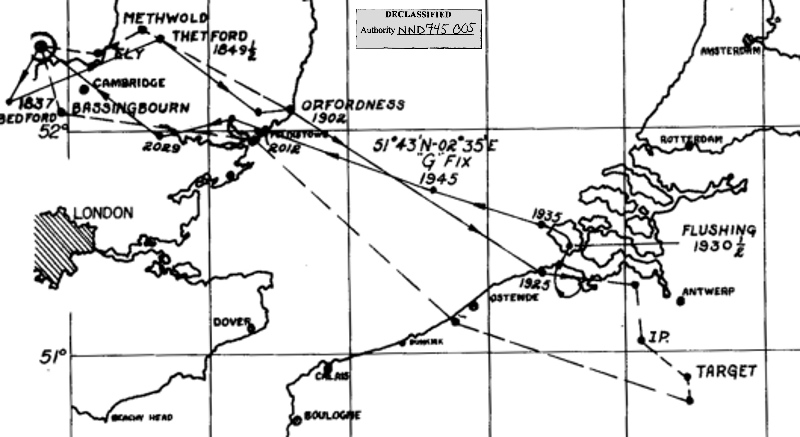
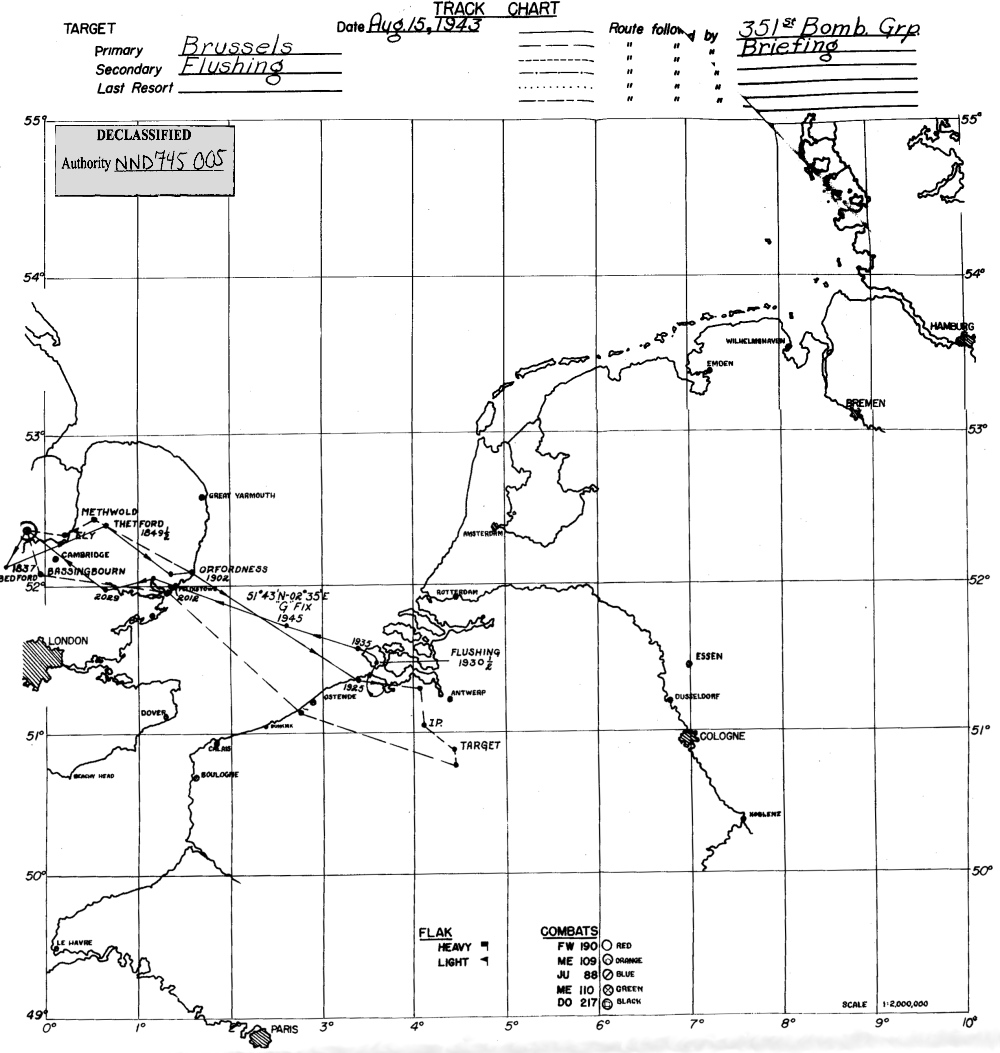
Track Chart:
Click on Chart to Enlarge


Flak Report:

Target - Flushing (Brussels)
1. Route followed. - Route followed: Over Breskens along south bank of Hente of Westerschelde – right turn prior to Neusen –
   continuing large circle over [unreadable], Sluis, Knocke, to a point just SW of Flushing – left turn to 38 degrees over Flushing –
   continued left turn to Middleburg out over Domburg.
2. Visibility at Target. - No trails – Visibility at target fair – 3/10 clouds.
3. No. of A/C over Target: No trails – Visibility at target fair – 3/10 clouds.
4. General Axis of attack. - 32 degrees mag. [Magnetic]
5. How long did formation fly straight and level before bombing? - Bombed while in slow turn.
6. Turn after bombing. - Continued turn to left.
7. Position of Group in relation to other Groups: 91st lead – 351st low – 381st high (aborted)
8. What evasive action was taken? - Loss of altitude – slow turns.
9. A short description of Flak en route. - Continuous following throughout. Flak first encountered from tip of Breskens and Flushing,
   continued along south bank of bay. No flak in turn until near Knocke where batteries to south engaged meagerly. At
   run over target flak was moderate and good for altitude was poor for deflections. In following course out 5 to 10 batteries
   were spotted at coast line just out of Flushing, running almost to western tip of island. At Domburg several guns were also
   seen. Flak ship 5 miles NW of Domburg fired 8 to 10 bursts on return. Black white and some red flak at target. White generally
   low. Crews commented on the smaller size of flak bursts. One crew reported larger size black bursts that seemed to explode
   to 3 times in succession and close together.
10. Any other comments, phenomena, etc. -


Crew Comments:

1. Following are the crew comments as determined by interrogation:

A/C 925 – Transportation should be waiting for us; whole crew waited 40 minutes for it. – Lt. Carraway.
A/C 868 – Not so much fooling around over enemy territory at low altitude. Too many gunners playing with guns on way back
      across channel – very dangerous. Do not like incendiaries. – Lt. Kern.
A/C 716 – Gunners should not fire guns indiscriminately on way back; keeps everyone on edge. – Lt. Suit.
A/C 762 – Crew got hungry. – Unanimous.
A/C 823 – Very bad formation. No good. – Lt. Peck.
A/C 839 – Oily surface of parking area tracks oil into plane creating a fire hazard. Tracers from indiscriminate firing coming home
      endangered the ship. – Lt. Hansen.
A/C 851 – Some gunner in 91st low squadron lead Group and #3 man in lead squadron of our Group, both firing back through
      formations. Recommend fly low squadron without #2 in lead element. – Lt. Argiropulos.
A/C 824 – Crew got hungry. – Unanimous
A/C 090 – 91st gunners careless – shooting too close to our Group. – Lt. Hull.
A/C 848 – Couldn’t get beacon at Bassingbourne. – Lt. Johnson.
    If possible, apples or something like it along with other food. – Unanimous.
[Signed] JOHN L. SCOTT, Major, AC, Group S-2


Hot News:
  1. No friendly aircraft were observed to be in distress on the Mission of 15 August, 1943.
[Signed] ROBERT B. STRATTON, 1st Lt., Air Corps, Statistical Officer


Mission Summary Report:
  1. Aircraft which failed to reach targets:
    1. Abortives:
      1. Airplane No. 42-29877, 511th Squadron, returned early because of #3 supercharger failure.
    2. Spares:
      1. Airplanes No. 42-3120 and 42-29749, 509th Squadron, returned early as scheduled.
  2. Battle Damage:
    1. Airplane No. 42-29882, 508th Squadron. One small flak hole leading edge right wing.
    2. Airplane No. 42-3090, 508th Squadron. One flak hole top left wing.
    3. Airplane No. 42-29848, 510th Squadron. Flak damage to co-Pilot’s windshield, necessitating replacement.
    4. Airplane No. 42-29831, 510th Squadron. Skin hole leading edge left wing caused by flak. Flak hole left bomb bay door. Two skin holes top right wing caused by flak. One skin hole left wing tip caused by flak.
    5. Airplane No. 42-29851, 508th Squadron. One flak hole right aileron through fabric.
    6. Airplane No. 42-29824, 511th Squadron. One flak hole leading edge right stabilizer.
TOTAL DAMAGED - 6, MAJOR - 0, MINOR - 6, BY FLAK - 6
[Signed] OTTO R. VASAK, Captain, Air Corps, Group Engineering Officer


Malfunctions:
  1. Following are the malfunctions as determined by interrogation:
    1. A/C 762 – S/Sgt J. W. De Graff – Belt feed pawl arm defective on both tail guns.
    2. A/C 823 – T/Sgt E. S. Schreiber – Heater plug in radio room out.
    3. A/C 855 – S/Sgt A. Terlizzi – Runaway gun in ball turret.
    4. A/C 716 – S/Sgt L. A. Lechen – Left Waist Gun fired only one shell at a time.
    5. A/C 812 – S/Sgt C. H. Simons – Tail gun oil buffer defective. Unanimous – Leak in oxygen system; couldn’t have lasted ½ hour more.
    6. A/C 868 – Lt. J. N. Schenck – Intervalometer failure.
[Signed] JOHN L. SCOTT, Major, AC, Group S-2 [Intelligence]


Armament Report:
  1. The following malfunctions and failures were reported upon the completion of the Mission of 15th August, 1943.
    1. A/C 42-29868 – had an Intervalometer failure.
    2. A/C 42-29835 – had a runaway gun in the Ball-Turret.
    3. A/C 42-29863 – had an Intervalometer failure.
  2. The necessary repairs and adjustments have been made.
[Signed:] MICHAEL STEELE, WO, (JG), AUS, Group Armament Officer


Deficiencies and Disabilities:

1. The following are the deficiencies and disabilities as determined by interrogation following the mission of August 15, 1943.
A/C 948 - S/Sgt. Nelson - Suit operated alright until 19000 ft. altitude, then gloves and boots gave no heat and suit very little – changed to 24-volt plug and suit gave better heat. No heat in gloves or boots.
A/C 848 - S/Sgt Bigham - Trouble with heated gloves, caused loss of both heated gloves and heated boots.
A/C 807 - Oxygen System in nose leaks, trouble traced to Bombardier’s regulator.
A/C 812 – Waist Gunner’s heated suit cord broken. Tail Gunner’s oxygen mask defective.
A/C 925 – Radio compass was defective.
[Signed] HERBERT L. FLIESCHER, 2nd Lt., Air Corps, Group Equipment Officer


Pilots Explanation to Abort:

Aircraft No. 42-29877 Squadron - 511   Pilot - Milton Sherman, 2nd Lt, Air Corps
Time of Abortive - 1800  Location when Aborted - Ely
Reason - #3 supercharger cut out at 20,000 feet
Enemy Opposition Encountered - None
[Signed] Milton Sherman


“J” Form:
  1. Total No. A/C in each Squadron and Letters of each:
    Sqdn 508th A/C: 851–J, 868–K, 090–N, 882–L, 823–C, 716–A (6)
    Sqdn 509th A/C: 863–Y, 749–Z, 812–U, 120–O (4)
    Sqdn 510th A/C: 925–L, 848–F, 948–B, 831–H, 762–D, 839–C (6)
    Sqdn 511th A/C: 877–X, 807–T, 849–U, 835–Y, 824–S (5)
  2. Target: Primary ZB-863B - Secondary - ZH-64
  3. Station call sign and Operational call sign respectively of each Squadron
    Squadron508 Ops:9PVSquadron510 Ops:QJ1
    Sta:PanpipeSta:Backward
    Squadron509 Ops9PVSquadron511 Ops:QJ1
    Sta:SprocketSta:Pointer
  4. Taxi Time – 1st A/C 1715;     Take-Off Time 1st A/C 1730;     E.T.D. Over Field 1836
  5. Time:Height:  Place of crossing English Coast OUT:
    185822,000 Ft Oxfordness
  6. Time:Height:  Place of Recrossing Enemy Coast:
    200222,000 Ft Nieuport
  7. Time:Height:  Place of crossing English Coast IN:
    204116,000 Ft Felixstowe
  8. E.T.R.(Estimated Time of Return): 2105 Hours
  9. MF/DF [Medium Frequency/Direction Finder] Section: D
  10. Bomb load of Each A/C:
    Squadron: 508 16–300 pound, Fuse - 1/10 Nose, 1/100 Tail
    Squadron: 509 16–300 pound, Fuse - 1/10 Nose, 1/100 Tail
    Squadron: 510 16–300 pound, Fuse - 1/10 Nose, 1/100 Tail
    Squadron: 511 16–300 pound, Fuse - 1/10 Nose, 1/100 Tail
  11. Fuel Load of each A/C: 1700 Gallons
  12. Actual Times Off and Return by Squadrons and A/C Letters:
    SquadronA/C LetterA.T.O.A.T.R.SquadronA/C LetterA.T.O.A.T.R.
    508851–J1739½2058509863–Y1730½2050
    868-K17402059Spares  
    090-N1740½2100749-Z1737½2009
    882-L17412101½812-U1738½2054½
    823-C1741½2103 120-O17382011
    716-A17422104
    510925–L17342104½511877-X17311919
    848-F1734½2106½807-T1731½2052½
    948–B17352107849-U17322053½
    831-H1735½2107½835-Y1732½2051
    762-D1736½2108824-S17332056
    839-C17372109   

    Report Compiled By C.A. Blanchard, S/Sgt.


Formation Chart:
Group Formation Take–Off
511th Squadron
Blaylock–Burns
A/C #42-29863 Y
Maser
A/C #42-5807 T
Sherman
A/C #42-29877 X
Morse
A/C #42-29849 U
Nardi
A/C #42-5824 S
Wilson
A/C #42-29835 Y
508th Squadron510th Squadron
Argiropulos
A/C #42-29851 J
Carraway
A/C #42-29925 L
Hull
A/C #42-3090 N
Kern
A/C #42-29868 K
Kelly
A/C #42-29948 B
Roberts
A/C #42-29848 F
Geiger
A/C #42-29882 L
Frisholz
A/C #42-29831 H
Suit
A/C #42-29716 A
Peck
A/C #42-5823 C
Hansen
A/C #42-29839 C
Smith, R.E.
A/C #42-29762 D
 
O'Mohundro
A/C #42-29749 Z
  
Harris, D.
A/C #42-3120 O
Harris, E.
A/C #42-29812 U


Group Formation Over–Target
511th Squadron
Blaylock–Burns
A/C #42-29863 Y
Maser
A/C #42-5807 T
Wilson
A/C #42-29835 Y
Morse
A/C #42-29849 U
Nardi
A/C #42-5824 S
Harris, E.
A/C #42-29812 U
508th Squadron510th Squadron
Argiropulos
A/C #42-29851 J
Carraway
A/C #42-29925 L
Hull
A/C #42-3090 N
Kern
A/C #42-29868 K
Kelly
A/C #42-29948 B
Roberts
A/C #42-29848 F
Geiger
A/C #42-29882 L
Frisholz
A/C #42-29831 H
Suit
A/C #42-29716 A
Peck
A/C #42-5823 C
Hansen
A/C #42-29839 C
Smith, R.E.
A/C #42-29762 D

Time Schedule:
Zero Hour: 1915  Briefing: 1445  Stations: 1605  Start Engines: 1705  Taxi: 1715   Take-off: 1730  Rendezvous: _____
Return to Base: _____

 [Wounded - 0]
The above records were obtained at the National Archives Records Administration and have been declassified by authority NND 745005
Please contact us with your comments and corrections.