351st Bomb Group

Polebrook, England

Group Mission #38

Credited Mission #35

 
DATE: 9 Sep. 1943
Target: Lille-Nord Aerodrome, France
 
Outline for Briefing:

  1. Roll Call and Airplane Assignments.
  2. Target:
    1. Name – Lille Norde Airdrome
    2. Location – Lille
    3. Name of Secondary – Chievree
    4. Location of Secondary – Belgium
    5. Name of Last Resort – Any Airdrome
    6. Location of Last Resort –
  3. General Information On Formation
    1. Wing formation – 101, 102, 103
    2. Order of Groups in formation and altitude of each – 351st - 24,000
    3. Our formation for bombing – Group Defensive
  4. Pursuit Coverage -3 Squadrons of P-47's as general area support from French coast to target and return.
  5. Diversions - Two Combat Wings of the 4th Wing to Paris.
    Two Combat Wings of the 4th Wing to Beauvals-Tille
    102 CW to Lille Lendeville
    One CW to St Omer - B24s
    One CW to Abbeville - B24s
    103 CW to Vitry-en-Artois
    Mediums in area ten minutes ahead of us.
  6. Navigator:
  7. Stations –0420
    Start Engines –0520
    Taxi –0530
    Take off –0545
  8. Don't leave gun stations until -
  9. Weather -
  10. S-2 [Intelligence] –
    1. Bomb Load is – 24 x 120 Frag [Fragmentation] Clusters
    2. IAS [Indicated Air Speed] for bombing is – 155
    3. I.P. [Initial Point of Bomb Run] Signals are:
      1. VHF - Channel A
      2. Aldis Lamp
      3. Leader will open doors
    4. Open Doors - two minutes before target.
  11. Special Briefing for all Officers of lead crews in Group S-2 [Intelligence]
  12. Special instruction to all personnel: No speculation on the significance, no voiced opinions, on pain of Court Martial.

    Gunners, Radio operators, Navigators and Bombardiers leave the briefing room.
  13. Comments to improve the formation and improve evasive action:
  14. Climb at 150 IAS [Indicated Air Speed]
    Cruise at 160 IAS
    Reform after attack at 155 IAS
    Descend at 170 IAS and 500 feet per minute.
  15. Any questions on who takes over the lead at anytime?
  16. Special instructions in case of bad weather: Let down splasher #9 - 270 degrees [Compass Heading].
  17. Call signs:
    101 C.W. [Combat Wing]Goonchild
    102 C.W.Bullpen351 GroupJ
    103 C.W.Fatgal381 GroupL
  18. Identification colors:
    101 C.W.RR [Red Red]
    102 C.W.YY
    103 C.W.GG
  19. Bomber to Bomber freq. - Channel A.
  20. VHF Channel (Bomber to Fighter) - Channel D
  21. Bomber to Fighter Call Signs:
    1. Bombers - Phonebox Three
    2. Fighters - Haybank
    3. Ground - Jack-Knife
  22. Turn on VHF [Very High Frequency Radio] at Takeoff - Check Button Frequently.
  23. Colors of the day:
    TimeColorIdent.Challenge
    0100 - 0700RYOL
    0700 - 1300GGVI
  24. Taxi Plan.
  25. Spare Ship Plan.
  26. Any Questions?


Operations Narrative:
  1. The take-off of nineteen (19) aircraft of the 351st Group was delayed by a bad ground fog. However, rendezvous was made with the 381st Group at Hertford.
  2. The rest of the route, both to and from the target, was flown as briefed.
  3. Bombs were away at 0833. Photographic results indicate that hits were made on the outer margin of the southwest corner of the field.
  4. No enemy aircraft were encountered. Flak, when encountered, was meager and accurate. We suffered no damage from it.
  5. The P-47 fighter support appeared as planned and gave excellent cover.
  6. One of our aircraft was unable to take off due to the weather conditions. Three (3) aircraft landed at Ashbourne and one (1) at Nuneaton, to await better weather before returning to base.
  7. All of our aircraft returned safely.
[Signed:] THEODORE R. MILTON, Lt. Col, Air Corps, Operations Officer


Bombardier's Narrative:
  1. The IP [Initial Point of Bomb Run] was reached at 0829. The turn on course to the Target was uneventful. The target area was not immediately identified, but by doing pilotage it was possible to remain on course.
  2. When the target area was identified, the aiming point was selected and the synchronization operation completed. Synchronization was on at bomb release. Mild evasive action was taken.
  3. The Lead Bombardier sighted for range and deflection. The leader of the second element in the Lead Squadron sighted for range only.
[Signed] Archer M. Baird, 1st Lt, Air Corps, Lead Bombardier.


Group Leader's Narrative, Mission No.22, Hamburg, Germany.
  1. A delay in the take-off was caused by a ground fog that moved in a short while before the scheduled time. It was possible, however, for us to take off in the time to make good the rendezvous with the 381st Group. The assembly of the 101st Combat Wing was satisfactory and every point was reached as scheduled.
  2. Light flak was encountered over the French coast and over the Target. Bombs were away at 0833; and were observed to hit over the aiming point and on the field. The bombs of the lead ship were salvoed. The C-1 Autopilot was used.
  3. The fighter cover away from the Target was excellent. No enemy fighters were met.
  4. The entire flight was made with no unusual occurrences.
  5. The combat wing dispersed at Luton and the 351st Group proceeded to Base. A heavy ground fog was in the process of breaking up at the time of our arrival.
[Signed:] ELZIA LEDOUX, Major, AC, Group Leader


Combat Bombing Flight Record:

Bombardier - Lt. Archer N. Baird   Pilot - Maj. Elzia Ledoux Navigator - Lt. Joseph D. Kitko
Aircraft # 42-29825  Take-off - 0622  Landed - 1009
Objective - Lille-Nord A/D [Airdrome, France]
Aiming Point - Center of Southern half of A/D
Initial Point - 50°52'N, 02°43'E
Method of Attack - Group
Number of Planes in Unit - 19
Number of Planes in Each Unit Performing Sighting Operations - 2
Time of Attack - 0833 Time of Release -
Approx. Length of Straight Approach - 35 seconds
Synchronization - On
Information at Release Point:
Altitude, True Above Target - 24,600 feet
Calculated Indicated Air Speed - 155 M.P.H.
True Air Speed - 232 M.P.H.
Wind Direction - 288° True
Wind Velocity - 38 M.P.H.
True Heading - 143°
Drift - 3°
True Track - 140°
D.S. - 141.1  Trail - 150   ATF - 49.38   Ten. D.A. - .37
Type of Release - Train
Point of Impact If Seen - Target Area
Winds - Altitude - 24,000  Direction - Est. 288 Actual 288  Velocity - Est. 38 Actual 38 Temp C. - Est. -24° C. Actual -25° C. All ships in formation released on Group Leader except 2nd element of lead Squadron.


Intelligence S-2 Narrative:
  1. The target for 9 September 1943 was the Lille-Nord Aerodrome in France. Bombing results by 19 A/C dropping 454 frag [fragmentation] clusters on the primary target were fair, most bursts being in the SE corner of the field and some distance past it.
  2. Twenty (20) A/C [Aircraft] were scheduled for the mission, but weather prevented the last plane from taking off. There were no abortives and no losses in this Group, but fog and clouds made it necessary for four (4) of our planes to land away from home base before proceeding here later. All have now returned to base.
  3. No E/A [Enemy Aircraft] were encountered by our Group for P-47 fighter support appeared as briefed and gave excellent close cover to our formation. We suffered no personnel casualties.
  4. Flak was encountered at only two places, Calais and over the target. Bursts were black and white, meager, but accurate for both height and deflection. Our planes managed to avoid flak damage, however.
  5. The weather was CAVU [Ceiling and Visibility Unlimited] over the target, but fog and clouds hindered both take off and landing in England.
  6. A large amount of friendly shipping and convoy activity was observed, and a smoke screen was observed South of our course in. Several of our A/C observed tanks and armored vehicles patrolling the Dunkerque area, and a motorized convoy moving west on the highway out of Ypres. Two new excavations and general construction work was seen just over the enemy coast South of Bourbourg-Ville. One A/C observed a large group of new barracks and buildings near the coast about ten miles South of Ostend. What appeared to be a new landing field was observed at Tournes near the coast on the route out.
[Signed:] JOHN L. SCOTT, Major, Air Corps, Group S-2 [Intelligence]


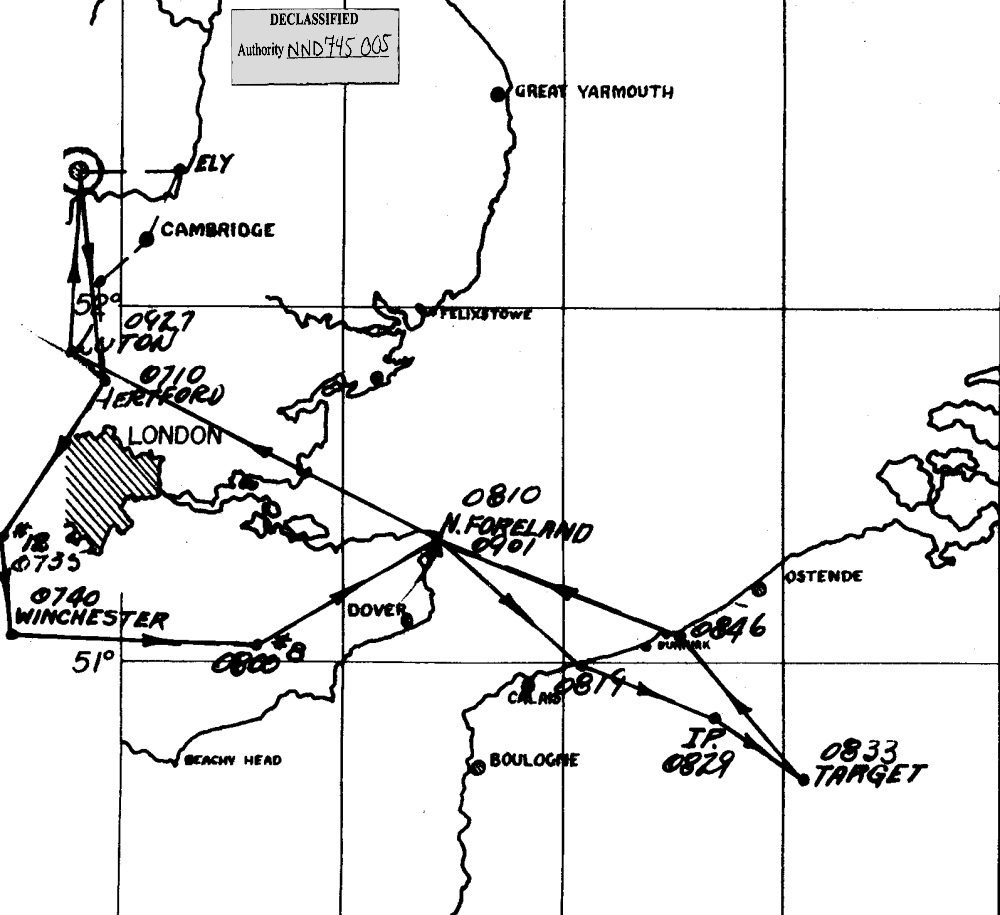
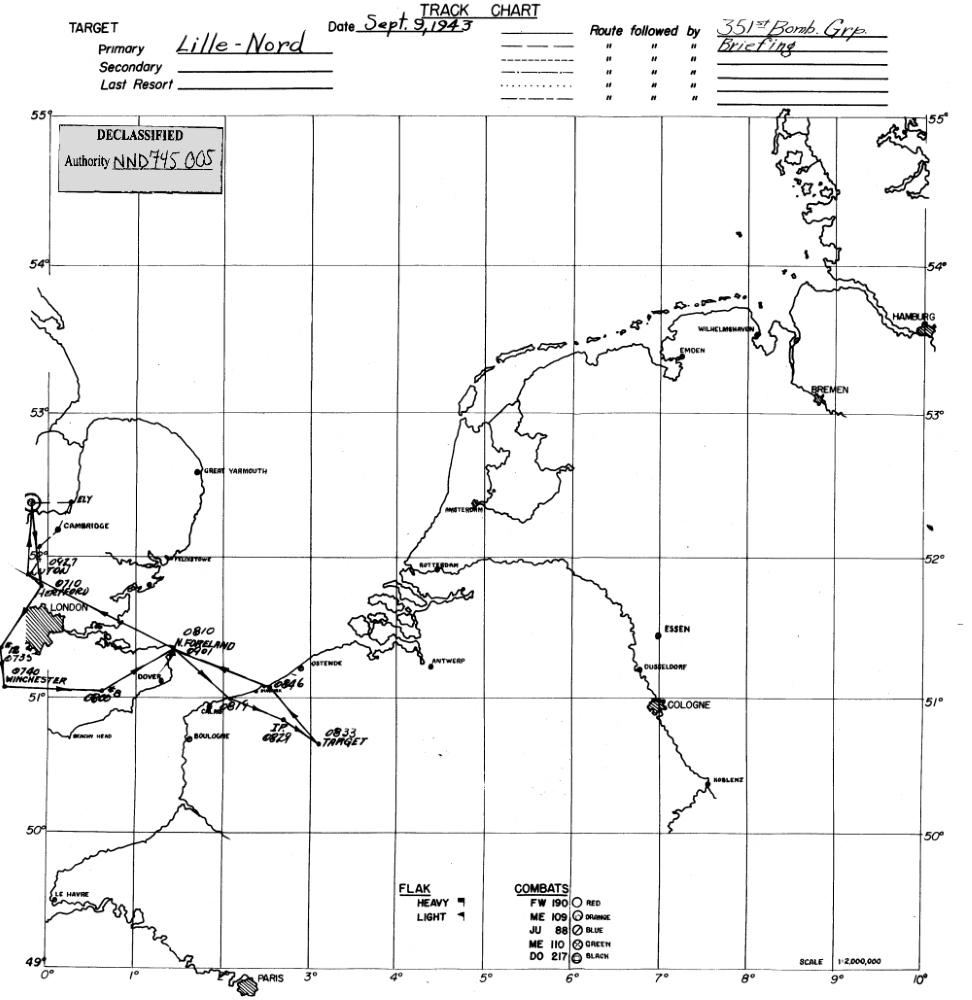
Track Chart and Combat Duplication Check Form:
Click on Chart to Enlarge


Information written in the book "The 351st Bomb Group in WWII" by Ken Harbour & Peter Harris. Used with permission.

On this mission T/Sgt. Martin M. Keniston of the 508th Squadron became the first member of the Group to complete 25 combat missions.


Report on Mission:
  1. In compliance with Co-ordination Memorandum No. 3, 19 July, 1943, the following data on the Mission of 17 August is submitted.
      1. No. of Aircraft Assigned: 20
        No. Failed to Take-off: 0
        No. of Abortives: 0
        No. Missing: 0
      1. The 351st Group flew the Lead Combat Box of the 101st Combat Wing Formation.
      2. The bombing altitude was 24,600 feet (true altitude above target).
[Signed] Robert B. Stratton, 1st. Lt., Air Corps, Statistical Officer


Flak Report:

Target - Lille-Nord A/F [Airfield], France
1. Route followed. - N. Foreland – Gravelines - 50°52’N - 02°19’E – target – halfway between Dunkerque and [unreadable – appears to be Nieuwpoort, France] – N. Foreland [England].
2. Visibility at Target. - Good – Some contrails visible.
3. No. of A/C over Target: 19
4. General Axis of attack. - 143°
5. How long did formation fly straight and level before bombing? - 35 seconds
6. Turn after bombing. - Left turn to 320° True
7. Position of Group in relation to other Groups: Lead Group of 101 CW, with 381 Group low.
8. What evasive action was taken? - Mild right and left turns – about 10° no loss of altitude
9. A short description of Flak en route. - Our formation flying at 24,000 feet encountered meager accurate flak from Calais while crossing the enemy coast at 0814-0818. Some bursts were also observed several thousand feet below, possibly from light guns at Gravelines. At the target at 0832-0834, flak was meager to moderate and accurate for both height and deflection. Reports indicate that continuous following was used throughout.
10. Any other comments, phenomena, etc. - None


Crew Comments:
  1. The following crew comments were made following the mission of this date:
    1. A/C 860 – Damned good support – Lt. Harris
    2. A/C 9812 – Side arms should be returned – Lt. Maginnis; Maintain same complete fighter cover – Lt. Maginnis
    3. A/C 861 – Crew using 861 before this trip should leave ship intact and clean the Guns - Lt. Strouse
    4. A/C 824 – Enlisted men need better food for breakfast – All gunners
[Signed:] JOHN L. SCOTT, Major, Air Corps, Group S-2 [Intelligence]


Submission of Hot News Summary, Combat Duplication Check Form and Combat Report Form:
  1. Due to the fact that no friendly aircraft were observed to be in distress and that no combat claims have been submitted, the following reports are not submitted:
    1. Hot News Summary
    2. Combat Duplication Check Form
    3. Combat Report Form
[Signed:] ROBERT B.STRATTON, 1st Lt., Air Corps, Statistical Officer


Mission Summary Report:
  1. Aircraft which failed to reach target.
    1. None
  2. Battle Damage.
    1. None – Skin scratched on two aircraft were so minute as to be negligible.
[Signed:] OTTO R. VASAK, Captain, Air Corps, Group Engineering Officer


Armament Report:

1. There were no armament malfunctions or failures reported upon the completion of the Mission of 9 September 1943.
[Signed:] MICHAEL STEELE, W/O (JG), AUS, Group Armament Officer


Deficiencies and Disabilities:

1. Following are the deficiencies and disabilities as determined by interrogation of the morning mission of 9 September 1943:
A/C 140 – Heated gloves and boots out – Sgt. Anker
A/C 861 – Light is out of ball turret – Sgt. Major
A/C 852 – Intervalometer out – Lt. Shames
A/C 824 – Need new heated boots and gloves – Sgt. Happold, Sgt. Burton
[Signed:] JOHN L. SCOTT, Major, Air Corps, Group S-2 [Intelligence]


“J” Form:
  1. Total No. A/C in each Squadron and Letters of each:
    Sqdn 508th A/C: 851–J, 868–K, 823–C, 882–L, 821–F, 858–G(6)
    Sqdn 509th A/C: 860–W, 630–S, 9812–U, 861–X, 140–P(5)
    Sqdn 510th A/C: 850–G, 152–A(2)
    Sqdn 511th A/C: 825–Z, 852–V, 824–S, 807–T, 849–U, 835–Y, 603–R,(7)
  2. Target: Z-281
  3. Station call sign and Operational call sign respectively of each Squadron
    Squadron508 Ops:V3VSquadron510 Ops:GS3
    Sta:PanpipeSta:Backwald
    Squadron509 OpsV3VSquadron511 Ops:GS3
    Sta:SprocketSta:Pointer
  4. Taxi Time – 1st A/C 0530;     Take-Off Time 1st A/C 0545;     E.T.D. Over Field 0647
  5. Time:Height:  Place of crossing English Coast OUT:
    081024,000 Ft North Foreland
  6. Time:Height:  Place of Recrossing Enemy Coast:
    184124,000 Ft 51°05'N-02°32'E
  7. Time:Height:  Place of crossing English Coast IN:
    085820,000 Ft North Foreland
  8. E.T.R.(Estimated Time of Return): 0947 Hours
  9. MF/DF [Medium Frequency/Direction Finder] Section: N
  10. Bomb load of Each A/C:
    Squadron: 508 24–120 lb. Frag. [Fragmentation] clusters
    Squadron: 509 24–120 lb. Frag. [Fragmentation] clusters
    Squadron: 510 24–120 lb. Frag. [Fragmentation] clusters
    Squadron: 511 24–120 lb. Frag. [Fragmentation] clusters
  11. Fuel Load of each A/C: 1700 Gallons
  12. Actual Times Off and Return by Squadrons and A/C Letters:
    SquadronA/C LetterA.T.O.A.T.R.SquadronA/C LetterA.T.O.A.T.R.
    508851–J0637½1003509860–W06231009
    868–K06381004630–S06351010
    823–C0638½10059812–U06241012
    882–L06391006861–X06321013½
    821–F06410959140–P06341007
    858–G--   
    510850–G06271011511825–Z06221008½
    152–A06361002852–V06251017
       824–S06261018
       807–T0630½ 
     LandedRAFAshbourne849–U06281020
     LandedRAFAshbourne835–Y06301020
     LandedRAFAshbourne603–R06511020

    Report Compiled By ____


Formation Chart:
Group Formation Take–Off
509th Squadron
Ledoux – Johnson
A/C # 42-29825 Z
Leimbeck
A/C # 42-29630 S
Harris, D.
A/C # 42-29860 W
Koszarek
A/C # 42-29850 G
Strouse
A/C # 42-29861 X
Maginnis
A/C # 42-29812 U
508th Squadron511th Squadron
Argiropulos
A/C # 42-29861 X
Smith W.R.
A/C # 852 V
Cagle
A/C # 42-5823 C
Kern
A/C # 42-29868 K
Nauman
A/C # 42-5807 T
Nardi
A/C # 42-5824 S
Geiger
A/C # 42-29882 L
Norris
A/C # 42-29849 U
Peck
A/C # 42-29858 G
Turley
A/C # 42-29821 F
Maser
A/C # 42-29603 R
Wilson
A/C # 42-29835 Y
 
Spika
A/C # 42-3140 P
   
Christman
A/C # 42-3152 A


Group Formation Over–Target
509th Squadron
Ledoux – Johnson
A/C # 42-29825 Z
Leimbeck
A/C # 42-29630 S
Harris, D.
A/C # 42-29860 W
Koszarek
A/C # 42-29850 G
Strouse
A/C # 42-29861 X
Maginnis
A/C # 42-29812 U
508th Squadron511th Squadron
Argiropulos
A/C # 42-29861 X
Smith W.R.
A/C # 42-29852 V
Cagle
A/C # 42-5823 C
Kern
A/C # 42-29868 K
Nauman
A/C # 42-5807 T
Nardi
A/C # 42-5824 S
Geiger
A/C # 42-29882 L
Norris
A/C # 42-29849 U
Spika
A/C # 42-3140 P
Turley
A/C # 42-29821 F
Maser
A/C # 42-29603 R
Wilson
A/C # 42-29835 Y
 
Christman
A/C # 42-3152 A

Time Schedule:
Zero Hour: 0800  Briefing: 0230  Stations: 0445  Start Engines: 0520  Taxi: 0530   Take-off: 0545  Leave Base: 0647


Information written in the book "The 351st Bomb Group in WWII" by Ken Harbour & Peter Harris.
Used with permission.

On this mission T/Sgt. Martin M. Keniston of the 508th Squadron became the first member of the Group to complete 25 combat missions.


 [Wounded - 0]
The above records were obtained at the National Archives Records Administration and have been declassified by authority NND 745005
Please contact us with your comments and corrections.