351st Bomb Group

Polebrook, England

Group Mission #179

Credited Mission #173

 
DATE: 29 July 1944
Target: I.G. Farbenindustrie A.G. Plant,
Merseburg, Germany
 
Briefing Outline:
  1. Airplane and Crew Assignment Check.

  2. Time Schedule:
     Lead & High Box Low Box
    Stations   –0540Stations   –0550
    Start Engines –0550Start Engines –0600
    Taxi     –0600Taxi     –0610
    Take Off   –0615Take Off   –0625
    Last Take Off –0715Last Take Off –___

    Spl. #4 at 14,000’.
    Lead & DL [Deputy Lead] of each box will taxi 5’ [minutes] early and TO [Take Off] as soon as possible.

  3. Targets:
    Primary: Merseburg [Germany]
    Secondary: Any mil. inst.[military installation] in Germany or any A/D [Airdrome], M/Y [RR Marshalling Yard], RR Bridge, Rd. Bridges, enemy columns or convoy on rd., concentration of troops or equip. not adj. to a built-up area. Target must be pos. [positively] identified & a visual sighting must be made.
    Last Resort: Any mil. inst.[military installation] in Germany or any A/D [Airdrome], M/Y [RR Marshalling Yard], RR Bridge, Rd. Bridges, enemy columns or convoy on rd., concentration of troops or equip. not adj. to a built-up area. Target must be pos. identified & a visual sighting must be made.

  4. Loading:
    351 “A”: "B" 20 x 250 G.P.[General Purpose] 1/10 – 1/40 [Fuses]
    351 “B”: ____
    Composite:
    Nickels [Propaganda Leaflets] in Ship # - None
    Chaff: 360 units. Start at I.P. [Initial Point of Bomb Run] & continue for 15 minutes.

  5. Gasoline Loading: 2700 gallons
    Remarks: E.T.R. [Estimated Time of Return] – 13:55

  6.  Wing Formation  94th (A) CBW  94th (B) CBW  94th (C) CBW  Comp. CBW 
    Lead351st
    Low351st
    High351st

  7. Division Formation:
    PositionCBW [Combat Wing]TargetDeparture Time at Coast
    Lead41st “A”Merseburg0745
    2nd41st “B”Merseburg0747
    3rd41st “C”Merseburg0749
    4th41st “D”Merseburg0751
    5th 1st “A”Merseburg0753
    6th 1st “B”Merseburg0755
    7th 1st “C”Merseburg0757
    8th94th “A”Merseburg0759
    9th94th “B”Merseburg0801
    10th94th “C”Merseburg0803
    2nd Division468 A/CBremen
    3rd Division270 A/CMerseburg
    3rd DivisionLaon/Couvron & CoulommiersAirfields in France
    Marauders
    RAF [Royal Air Force]

    Remarks: 3rd Div. will precede 1st Div. along same route to attack Merseburg.
      Base reference alt. – 23,000’.
      Interval between CBW’s – 2 min.
      Div. [Division] Assembly Line – Spalding to Louth.

  8. Fighter Cover:
    • [Force][Latitude & Longitude][Call Sign]
      1 Group P-51 5340-0530  Balance 2-1 
      1 Group P-51 5230-0820 Front  Balance 2-2 
      1 Group P-51 5230-0820 Rear  Balance 2-3 
      1 Group P-51 5122-1052  Balance 2-4 
      1 Group P-51 Target  Balance 2-1 
      1 Group P-47 5208-0900  Balance 2-5 

  9. Group Assembly:
     94th "B" CBW 
    [Combat Wing]
    BoxAltitudePlace
    Lead 14,000'  Kings Cliffe 
    Low13,000'Kings Cliffe
    High15,000'Kings Cliffe

  10. Navigator - _____
  11. S-2 - _____
  12. Weather - _____
  13. Special Instructions to Gunners, Bombardiers, and Radio Operators:
    A. Type of Bombing Formation -
    B. Camera A/C to return – Lead Box – Hennegan V-509, Bennett N-665; High Box – Strange H-004, Muffett A-702;
      Low Box – Whitaker M-964, Weatherman S-318.
      Lead radio operators will not release chaff & will maintain constant watch on Division Frequency except in emergency.

  14. Squadron Leaders and Group Deputy report to Target Room. All but Pilots Dismissed.

  15. (A) Code Words –
    PFF Bombing –____
    Visual Bombing -In the Clear
    Authenticator –Royal Flush
    Recall -Pistol Packing Mamma
    Weather Code -TVIAB Hotmint D - Dog
    Release "CHAFF" -No code word to be used

    (B) Call Signs:
    Call SignFlaresRemarks
    351st LeadWoodcraft Baker LeadRY [Red Yellow]
    351st BWoodcraft Baker LowRR [Red Red]
    351st BWoodcraft Baker HighGG
    401st A
    401st B
    457th A
    457th B
    Composite
    1st C.B.W.
    40th C.B.W.
    41st C.B.W.
    Composite C.B.W.

    (C)
    U.S. FightersBalance 2
    R.A.F. Fighters
    BombersVinegrove 2-9
    U.S. Grnd. ControlColgate
    R.A.F. Grnd. Control

    Control Points:Fighter Reference Points:
    _____W - Beauvais
    _____H - Reims
    _____I - Bremen
    _____S - Dummer Lake
    _____T - Gottinger
    _____L - Halle
    _____E - Brussels

    Remarks: ____

    (D)
    Colors of the Day
    TimeColorLetterChallenge
    0200 – 0800
    0800 – 1400
    1400 – 2000

    (E) Ships To Monitor [Radio Channels A, B, C & D]
    1. - All except:
    2. - R-038, M-900, C-576
    3. - 8 AF – F-124, J-971, P-193
    4. - Avail. To all for A/S [Air Sea] Rescue.
  16. Let-Down on Kings Cliffe, if overcast.
    351st Lead   045° Mag. [Magnetic Compass Heading]
    351st Low   030° Mag.
    351st High   060° Mag.
    401st A   ___° Mag.
    457th A   ___° Mag.

  17. Flying Control. –
    1. Taxi Plan.
    2. Emergency Fields. - Langham (52°56’N-00°58’E)
    3. Landing Aids.

  18. Special Instructions:
    Spares turn back at 03° East.
    94th CBW – S.O.P. [Standard Operating Procedure] No. 19 to be read on VHF silence.
    On return – let down to the deck will be made between enemy coast & English coast.
    This target produces more than ½ again the finished oil product as compared to any other plant in Germany. Although optimistic about today’s work this plant is easily worth another effort. It is now producing at 75% capacity.


Operational Narrative – Lead Combat Box:
  1. Mission Date - 29 July, 1944.
    1. Target – Merseburg, Germany.
    2. Force – 94th “B” Combat Wing – Thirty-nine aircraft, including three flying spares, took off.
    3. Position – Second in 94th Combat Wing and ninth in First Division.
    4. Lead Team CBW Air Commander: Lt. Colonel Robert W. Burns.
      Pilot:Captain Sterling L. McClusky.
      Navigator:Lt. William F. Washburn.
      Bombardier:Captain Allan D. Behrendt.
  2. Narrative.
    1.  Group & Wing Assembly - Thirty-nine aircraft, including three flying spares, took off as planned, and assembled the group and combat wing formations at the Kings Cliffe buncher at 14,000 feet. No difficulties were encountered.
    2.  Route Over England – Flown as briefed. Departure from the assembly point was made one minute early, Spalding and Louth were reached two minutes early. The briefed altitude was maintained.
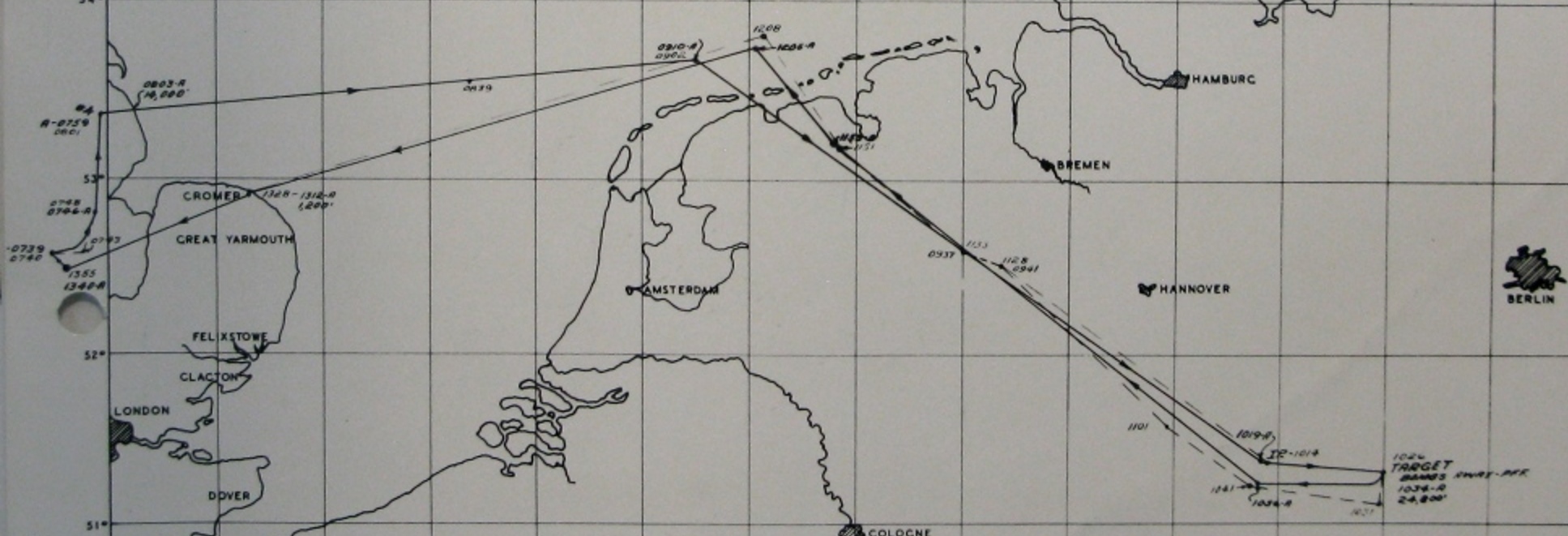
    3.  Division Assembly – The Division Assembly line was flown as briefed. The departure from the English coast was made at 0803 (2 minutes early) at the briefed altitude of 14,000 feet. The 94th “B” Combat Wing was in position behind the 94th “A” Wing. The 94th Combat Wing Formation made up the tail of the First Division Formation.
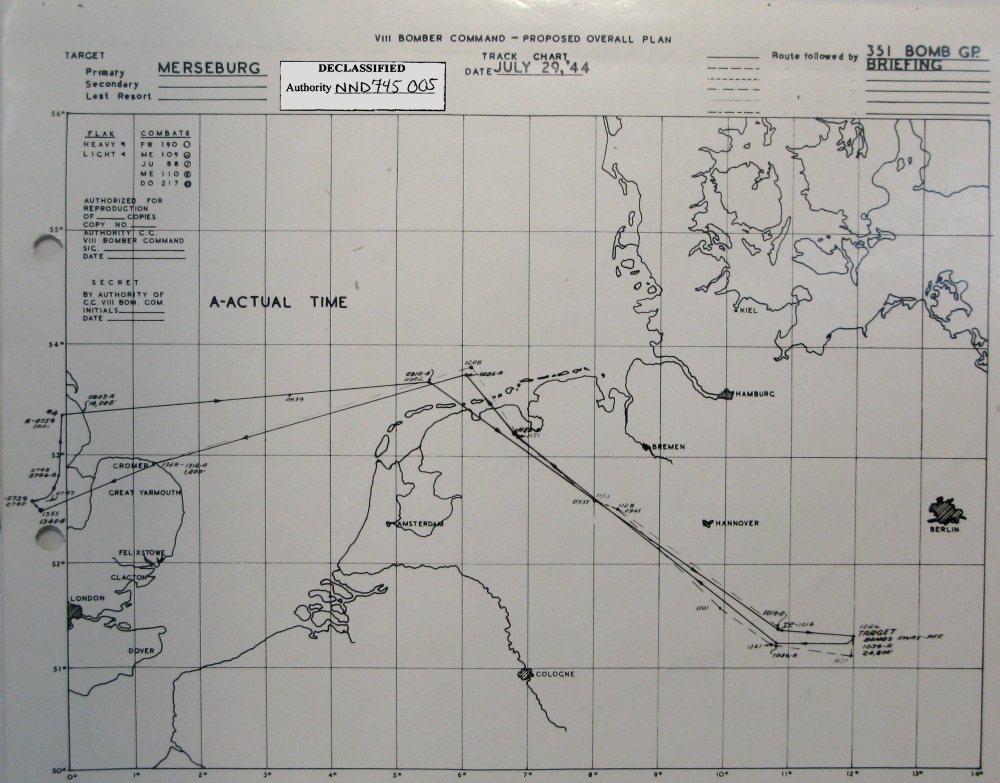
    4.  Flight to Target (English Coast to IP [Initial Point of Bomb Run]) – After the departure from the English Coast, the briefed route was closely followed. The enemy coast was crossed at the briefed point six minutes late. From the coast to the IP, there was some variance between the briefed and actual routes. Such variance was caused by the attempts of the Combat Wing Leader to avoid flak areas and to avoid the prop wash of preceding formations. Due to the fact that the formation was to the right of course, it was possible to make the left turn to the IP and have a somewhat longer approach to the target.
    5.  Description of Bombing Run (IP to Target) – Bombing was done by PFF [Pathfinder Force] methods. Results were not observed, but due to the presence of huge clouds of smoke in the area, it is believed that heavy damage was caused. The entire formation dropped on the PFF aircraft leading the formation. Accurate and intense flak was encountered in the target area. The target was obscured by smoke screen and smoke from previous bombing. The C-1 Pilot [Autopilot] was used with good results. A sharp turn was made at the IP. The bombing run was made for ten minutes. Bombs were released at 1034 from an altitude of 25,300 feet.
    6.  Flight From Target (Bombs Away to Base) – The course was flown nearly as briefed. The sharp turn after the target could not be made, and so the formation cut inside of the briefed route. The briefed route was followed with little variance on the withdrawal. Once again, sufficient variance from course to avoid flak and prop wash was made.  Departure from the enemy coast was made at 1200 on course. The briefed route was followed over the Channel. A normal letdown was made. The briefed route was followed to base and the English coast was crossed at Cromer sixteen minutes early (at 1312) at 1,200 feet. Return to base was made without further incident.
    7.  Fighter Support – Friendly fighter support was reported as having been very good with the exception of a short period after the target when enemy fighters were encountered.
    8.  Comments – Aircraft 42-38146, pilot Lt. Morton, is reported as having been hit by flak and exploding over the target. Three or four chutes were observed before the explosion.
        Flak was encountered over Jena and Dummer Lake on the route out. Flak at the target was intense and accurate.
        Visibility in the target area was good except for the area in smoke from bombing.
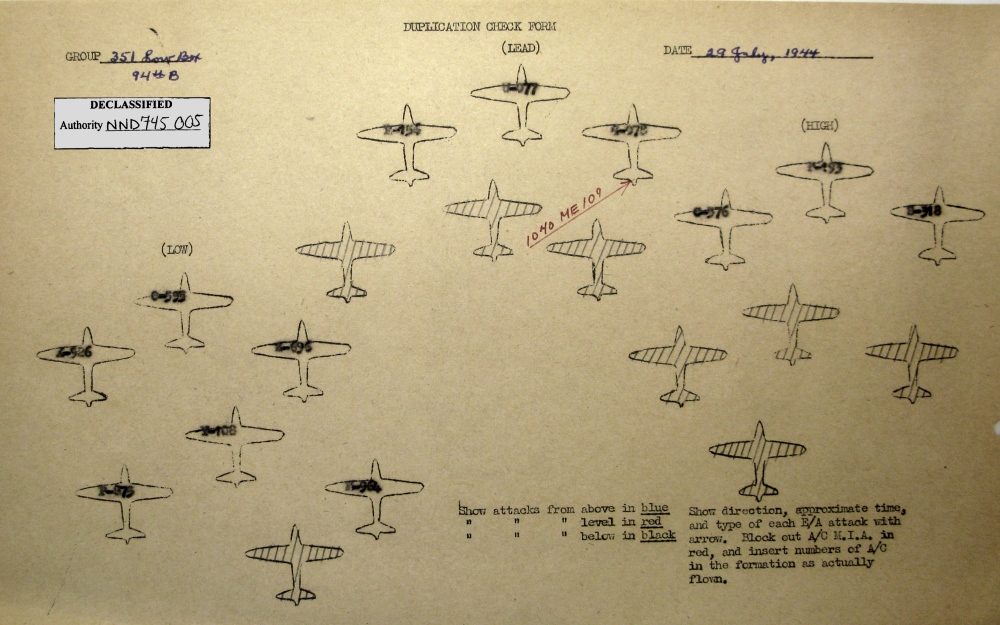
        Enemy fighters were encountered by the low box at 1040-1045 hours. One pass was made by four aircraft and a claim for one aircraft destroyed is made.
    9.  Aircraft Not Attacking – Lead Box. Aircraft 43-37553, pilot Lt. Belmeyer, returned from the assembly area with the report that the oxygen pressure was low. The flying spare replaced this aircraft.
        High Box. Aircraft 42-31192, pilot Lt. Merrill, returned from a point six miles NE of Louth with a feathered engine. The flying spare replace this aircraft.
        Low Box. The flying spare returned as planned.
    10.  PFF Aircraft – Two PFF aircraft were dispatched to each of the three groups of the 94th Combat Wing. All attacked the target with the exception of those sent to the 401st Group. One of these failed to take off and the other aborted.

  [Signed] Carl C. Hinkle, Jr., Major, Air Corps, Operations Officer


Statistical Summary:
94th “C” COMBAT WING FORMATION
Lead BoxHigh BoxLow BoxTOTAL
No. of A/C Failing to Take Off0000
No. of A/C Airborne13131339
No. of A/C Airborne Less Unused Spares13131238
No. of A/C Sorties12121236
No. of A/C Attacking12121236
No. of A/C Not Attacking1102
Name of Primary TargetMerseburg, Germany
(A) No. of A/C Attacking Primary Target12121236
(B) No., Size & Type Of Bombs 238 x 250# GP  240 x 250# GP  239 x 250# GP  717 x 250# GP 
Name of Secondary Target
(A) No. of A/C Attacking Secondary Target
(B) No., Size & Type Of Bombs
Name of Last Resort Target (LRT)
(A) No. of A/C Attacking LRT
(B) No., Size & Type Of Bombs
Name of Target of Opportunity (T.O.)
(A) No. of A/C Attacking T.O.112
(B) No., Size & Type Of Bombs18 x 250 HE*18 x 250 HE36 x 250 HE
No. of A/C Lost - Total0101
No. of A/C Lost - Flak0101
No. of A/C Lost - Flak and E/A
No. of A/C Lost - Enemy Aircraft
No. of A/C Lost - Accident
No. of A/C Lost - Unknown
Time of Take Off060506070608
Time of Attack103410341034
Average Time of Flight7:387:457:45
Altitude of Release25,300’25,900’24,700’
Visual or PFFPFFPFFPFF
Enemy Resistance – AA Intensity & AccuracyINTENSE AND ACCURATE
Enemy Resistance – Fighter0044
Enemy Resistance – Bombers000
U.S. A/C Engaged by Enemy Aircraft001212
Degree of SuccessRESULTS UNOBSERVED
[* - HE - High Energy Explosive]

PFF A/C were borrowed from Groups as follows: NONE
PFF A/C were loaned to Groups as follows: A/C 42-97649 & 42-97638 were loaned to the 457th Group and are reported as having attacked the target.
A/C 42-97701 & 42-97636 were loaned to the 401st Group. A/C 42-97701 failed to take off & A/C 42-97636 aborted.


Bombardier’s Narrative:

Lead Bombardier’s narrative for mission of this date:
  1. The 351st Bombardment Gp. (H) furnished the Lead, Low, and High Box for the 94th “B” Wing.
  2. Merseburg, Germany, the Primary, was bombed by PFF bombing in Wing formation. The High and Low Box dropped on the PFF A/C flying in the Lead of the Lead Box.
  3. Encountered heavy flak in the target area. Smoke screen and smoke from previous bombing covered the target.
  4. C-1 Pilot [Autopilot] was used with good results.
  5. A sharp turn was made at the I.P. [Initial Point of Bomb Run].
  6. Bombing results could not be observed.
  [Signed:] Allan D. Behrendt, Captain, Air Corps, Lead Bombardier, Lead Box 94th “B” Wing


Combat Bombing Flight Record:

Bombardier - Captain Behrendt, Allan D. 
Pilot - Lt. Colonel Burns, Robert W. & Captain McClusky 
Navigator - 1st Lt. Washburn, William F.
Aircraft B-17G   C-951  Take-off - 0605 Landed - 1443
Objective - Merseburg, Germany
Aiming Point (MPI) [Mean Point of Impact] - As briefed (PFF)
Initial Point -As briefed
Method of Attack - Wing
No. of Attacking A/C in Group: - 12   Composite Group - ____
Number A/C Dropping Bombs by own Sighting Operation: ONE
Deflection and Range Sighting, Group: Lead A/C   Composite Group - ____
Range Sighting only, Group - ____   Composite Group - ____
Bombs, Types and Sizes - 250 LB. AN-M57 G.P.[General Purpose]
Number of Bombs Loaded - 20   Released - 10
Fusing, Nose - 1/10   Tail - 1/40
Synchronization - P.F.F. On
Information at Release Point:   Target covered by smoke (PFF bombing)

Altitude of Target - 350’Magnetic Heading Ordered 100° Actual 100°
True Altitude Above Target - 25,300’True Heading 96°
Indicated Altitude - 25,000’Drift, Estimated 3° Left - Actual 3° Left
Pressure Altitude of Target +320True Track 99°
Altimeter Setting 29.92Actual Range 14,154'
Calculated Indicated Air Speed - 150KB.S. Type - M-9
True Air Speed - 228KTime of Release 1034
Ground Speed Est. 262 Actual 262Length of Bombing Run - 10 minutes
Wind Direction Metro - 250° Actual - 250°Intervalometer Setting - 100'
Wind Velocity Metro 30K Actual 30K C-1 Pilot [Autopilot] X [Used]
D.S. - 123.7  Trail - 93   ATF - 42.86A-5 Pilot _____
Tan. D.A, Est. .56 Actual 42.86 Manual Pilot - ____

Type of Release - Train
Point of Impact If Seen - Unobserved
Mean Temp. Metro -4 Actual -4
Winds - Altitude - 25,300 Ft.  Direction - Metro 250°  Actual 250°  Velocity - Metro 30  Actual 30
Temp C. - Metro -__° C. Actual -__° C.


Preliminary Damage Assessment:
  1. The target for the three boxes of this Group was the I.G. Farbenindustrie A.G. plant at Merseburg, Germany. The target area is obscured by smoke from fire and smoke screen generators.
  2. Bombs away can be plotted and, using information furnished by the Group bombardier, an approximate point of impact can be plotted. The pattern probably hit in the southern part of the target area, immediately east of the upper marshalling yard.
  [Signed:] Thomas L. Cooper, Captain, Air Corps, Group P.I. [Photo Intelligence]


Intelligence S-2 Reports:
  1. No Nickels [Propaganda Leaflets] were carried.
  2. Heavy black smoke was rising to an altitude of approximately 20,000 feet during our approach on the target. Bombing was done into the smoke by PFF and results unobserved. Pictures show a tremendous amount of smoke.
  3. The Low Box of this CBW, 94th “B”, was attacked by four ME-109’s from the tail between 1040 and 1045 hours just to the south of the target area. There was one pass made and one of the E/A was shot down by the combined fire power of this Box. The E/A were gray, and, after attacking the Low Box, passed out to the rear of the High Box. Claims are for one E/A destroyed.
  4. Flak at the target was intense and accurate for both height and deflection. Moderate accurate flak was encountered for approximately five minutes after leaving the target area. On the route out meager flak was observed over Jena and Dummer Lake.
  5. Three to five tenths cumulus clouds in the target region, with tops estimated at 10-12,000 feet did not interfere with formation or bombing.
  6. Marshalling Yards at either Lubbecke or those situated just West of Bad Oeynhausen were filled with traffic. A large factory site located in the vicinity of 51°25’N-10°45’E [Equidistant between Leipzig and Kassel, Germany] had one building which appeared to be devastated.
  7. A/C 146-D was hit by flak at “bombs away”. Either three or four chutes were seen before the A/C exploded. PFF equipment was used for bombing. Fighter support was good. There was none in evidence for a short time after the target, when then E/A [Enemy Aircraft] made their attack. However, the E/A numbered no more than four.


Track Chart and Combat Duplication Check Form:
Click on Chart to Enlarge


A.A. Gunfire (Flak) Report:

1. Target: Assigned - Merseburg, Germany Bombed - Merseburg, Germany
2. Route as Flown. - As briefed.
3. Weather Conditions - A. at Target. - 3-5/10ths  B. En route - 3-8/10ths
4. Were our A/C "Seen" or "Unseen" targets? (a) At Target - Seen (b) Enroute - breaks in clouds
 Any Condensation Trails? - ____
5. Description of Flak, including type of Fire Control: Flak at target was intense, black in color, and very accurate for both height and deflection. Moderate to meager flak, accurate for both height and deflection, encountered for approximately five minutes after target. Flak bursts appeared to be larger than normal. Continuous following fire control believed used.
6. Flak encountered or observed en route. (In the order experienced) -
 Jena – moderate – observed to left.
 Dummer Lake – meager – observed.
 Crews commented on excellent route to and from target from flak standpoint.
7. Was Chaff carried? - Yes How discharged? Normal discharge starting at I.P. [Initial Point of Bomb Run].
8. Position of Group - 94th “B” CBW. Lead, High, and Low Groups.
9. Group –
  Lead - A/C over enemy terr. – 12, A/C damaged – 4, A/C lost to flak – 0, Time over Target – 1033, 
    Time of bombs away – 1033, Height – 25,300’, Axis of attack – 98° Bomb run – 10 mins.
  Low- A/C over enemy terr. – 12, A/C damaged – 6, A/C lost to flak – 0, Time over Target – 1034, 
    Time of bombs away – 1034, Height – 24,800’, Axis of attack – 98° Bomb run – 10 mins.
  High - A/C over enemy terr. – 12, A/C damaged – 6, A/C lost to flak – 1, Time over Target – 1035, 
    Time of bombs away – 1035, Height – 25,800’, Axis of attack – 95° Bomb run – 10 mins.
10. Comments - Phenomena: ____


Combat Crew Comments:


    508th Squadron:
A/C 850-G: Fly higher! Too much prop wash from high squadron, Lead Group. – Lt. Muhleman.
A/C 920-L: If we are not going to have any more fighter support than we do, why not have 18 ship formations? – Lt. Ballard.
A/C 349-B: Would like U.S. candy for a change. – Lt. Jones.

    509th Squadron:
A/C 696-Z: Why send in 12 ship groups with so little fighter support? – Lt. Barker.
A/C 156-R: Glatton [457th] and Deenethorpe [401st] were talking over VHF right at time fighters were attacking us. It must have
    been Lead ships, as remarks ran “Did you see the target?” – “Did you bomb PFF?”, etc. We couldn’t get a word in on
    anything. They also talk all over England about really inconsequential things. Our silence does no good with their talking all
    the time. They should be told – please. – Lt. Guthrey.

    510th Squadron:
A/C 951-C: The enlisted men on this crew had the best interphone discipline I have seen, and are the best crew I have flown with. –
    Lt. Gootee.
A/C 038-R: Too much unnecessary comment on VHF by other Groups. – Lt. Matre.
A/C 124-F: Can’t get enough to eat in Mess Hall for breakfast. We get our rear eaten out every time we try to get seconds. –
    Enlisted Men.
    Had trouble getting ammunition from Armament; had to call twice for it. – Whole Crew.

  [Signed] Robert P. Ramsey, Major, Air Corps, Group S-2 [Intelligence]


Mission Summary Report:
  1. Abortives and Flying Spares:
    1. (High) Airplane No. 42-31192, 508th Squadron returned early. The pilot stated that #2 Propeller ran away on initial climb, and after entering formation #2 tachometer and oil pressure dropped off. The engine was then feathered. Airplane ground checked and flight checked and found satisfactory. No defects whatsoever could be found. (Reason: Personnel Error).
    2. (Low) Airplane No. 43-37676, 509th Squadron returned early as planned. (Reason: Flying Spare).
    3. (Lead) Airplane No. 43-37533, 511th Squadron returned early. The Pilot stated that there was a leak in the Pilot’s oxygen system. System was refilled and no leaks of any manner could be found. Apparently someone had opened the emergency system and let about 200 lbs. of oxygen out. (Reason: Personnel Error).
  2. Battle Damage:
    1. Flak hole underside of left wing near #1 engine. Skin, corrugation and air-duct damaged. Navigator’s window on right side of compartment cracked.
    2. Airplane No. 42-97349, 508th Squadron. Flak hole in leading edge of right wing between fuselage and engine. Skin, air scoop, brace, propeller governor cable and main fuel tank damaged.
    3. Airplane No. 43-37727, 508th Squadron. Two small flak holes on top of plexi-glass nose section. Small flak hole on top of #4 nacelle. Skin, push rod housing, oil line and prop feathering line damaged.
    4. Airplane No. 32-37920, 508th Squadron. Flak hole underside of left wing outer panel. Skin, corrugation and spar damaged. Flak hole on right side of navigator’s compartment, skin and stiffener were damaged.
    5. Airplane No. 42-97258, 508th Squadron. Two small flak holes in left horizontal stabilizer and elevator, skin and fabric were damaged. Small flak hole through left wing tip. Flak tear in leading edge of right wing outer panel about ten inches long and two inches wide. Skin damage only.
    6. Airplane No. 43-37964, 509th Squadron. Small flak hole underside of tail gunner’s compartment. Skin and ammo chute damaged. Flak hole through right stabilizer at joint of elevator and stabilizer. Stabilizer had to be changed. Small flak hole through right wing tip. Flak hole on top of wing behind #2 engine, skin corrugation, and intercooler damaged. Flak hole on top of fuselage forward of upper turret, skin and stringer damaged.
    7. Airplane No. 43-37595, 509th Squadron. Small flak hole through right stabilizer. Skin damage only. Small flak hole underside of left outer wing panel, skin damage only.
    8. Airplane No. 44-6156, 509th Squadron. Two small flak holes underside of Navigator’s compartment. Skin and stringers damaged. Small flak tear in fabric of left elevator. Small flak hole on top of #4 Engine nacelle, skin and oil line damaged.
    9. Airplane No. 44-6077, 509th Squadron. Flak hole in leading edge wing near fuselage. Skin, corrugation, oxygen bottles and electrical cables damaged. Small flak hole through left wing tip, skin damage only.
    10. Airplane No. 44-6108, 509th Squadron. Small flak hole through the center of dorsal fin, skin and stringer damaged. Small flak hole on cowling of #3 Engine. Two small flak holes through left wing tip, skin damage only.
    11. Airplane No. 42-97926, 509th Squadron. One 20 mm hole in trailing edge of wing behind #2 engine, skin, corrugation, stiffeners, fuel tank and bracing damaged. One 20 mm hole in trailing edge of left wing outer panel, skin corrugation, compression members, and Tokyo tank damaged. Flak hole on left side of Navigator’s compartment. Window, skin and nose gun mounting bracket damaged. Small flak hole underside of #4 Engine, skin and supercharger oil line damaged. #3 and #4 Propeller domes damaged by flak.
    12. Airplane No. 44-6078, 509th Squadron. Flak hole through left wing outer panel, skin, corrugation and Tokyo tank damaged. Flak hole underside of #2 Engine, skin and cooler cap damaged. Two small flak holes through left wing outer panel, skin and corrugation damaged. Three flak holes left of ball turret, skin, bulkhead, gusset and supercharger wiring damaged. Flak hole through dorsal fin, skin and stringers damaged. Two small flak holes through left elevator. Two flak holes in trailing edge of wing behind #4 Engine, skin corrugation, fuel tank and compression members damaged.
    13. Airplane No. 42-97193, 509th Squadron. Flak hole in leading edge of left wing outer panel, skin, corrugation, spar and Tokyo tank damaged. Small flak hole in trailing edge of wing behind #4 engine, skin damage only. Small flak hole in leading edge of left stabilizer, skin damage only.
    14. Airplane No. 42-107124, 510th Squadron. Small flak hole underside of wing near #1 engine, skin corrugation and Tokyo tank were damaged. Flak hole through right wing tip, skin, corrugation and former damaged. Flak hole underside of right wing outer panel on leading edge of wing, skin damage only. Flak hole in left side of fuselage at station #11, skin, circumferential and right elevator damaged when flak left fuselage.
    15. Airplane No. 43-37665, 510th Squadron. Small flak hole through rudder hinge. Small flak hole left side of navigator’s compartment, skin and stiffener [damaged]. Small flak hole underside of left wing near #1 Engine, skin, corrugation and fuel vent line damaged. Small flak hole underside of left wing outer panel, skin and corrugation and Tokyo tank damaged. Flak hole on right side of #3 nacelle, skin, and rubber connection of oil “out” line damaged. Small flak hole in trailing edge of right wing near fuselage, skin, and stringers damaged.
    16. Airplane No. 42-97951, 511th Squadron, PFF flew with 457th Bomb Group. Flak hole through right flap, skin and former damaged. Flak hole on top of wing behind #2 Engine, skin and corrugation damaged. Two flak holes through tip of dorsal fin, skin and main spar damaged.
    17. Airplane No. 42-97318, 511th Squadron. Flak hole on top of #1 engine nacelle, skin, hydraulic cowl flap line, oil tank vent line, supercharger oil tank, generator high tension leads, starter leads, and primer line damaged. Small flak hole through left aileron, skin of aileron damaged. Small flak hole in left flap, skin damage only. Small flak hole through right wing tip, skin and corrugation damaged. Small flak hole underside of right wing outer panel, skin, corrugation and Tokyo tank damaged. Small flak tear on left side of base of dorsal fin, skin and oxygen line damaged.
    18. Airplane No. 44-6139, 511th Squadron. Two small flak holes through left wing tip, skin and former damaged. Two small flak holes in underside of left wing behind #1 Engine, skin, corrugation and flap control rod damaged. Small flak hole through fuselage under right stabilizer, skin and stringer damaged.

    TOTAL A/C DAMAGEDMAJOR DAMAGEMINOR DAMAGEBY FLAKBY FLAK & FIGHTER
    18117171
  [Signed:] Carl A. Ekblad, Captain, Air Corps, Group Engineering Officer


Mission Summary Report:
  1. Abortives:
    1. Airplane No. 42-97636, 511th Squadron, PFF Aircraft flew with 401st Bomb Group. This aircraft returned early because #3 Engine was running rough. Investigation revealed a cracked exhaust stack on #1 cylinder of #3 Engine.
    2. No Battle Damage was received.
  [Signed:] Carl A. Ekblad, Captain, Air Corps, Group Engineering Officer


Armament Report:
  1. The following armament malfunction were reported on the Mission of 29 July, 1944.
    1. A/C 42-102576 – The bottom bomb on the left outboard rack was returned to base. The safety latch was weak and safety latch was not in position. The rear end of shackle came out of the rack thereby making it impossible to drop the bomb. After the bomb run, the bomb was rehung in rack. Reason was improper inspection of racks.
  [Signed:] Michael Steele, CWO, USA, Group Armament Officer


Aircraft Returning Early:

Aircraft No. 676 Squadron - 509th   Pilot - K.R. McCall
Time of Abortive - Flying Spare  Location when Aborted - ____
Reason For Abortive - Returned as briefed.
Disposition of Bombs: Brought Back.
Altitude At Time of Aborting: 13,500’
Enemy Opposition Encountered - ____
Remarks:
[Signed] K.R. McCall


Aircraft No. 7533 (511) Squadron - 510   Pilot - Belmeyer
Time of Abortive - 0700  Location when Aborted - Coming up on assembly point.
Reason For Abortive - Oxygen press. down to 200 lbs.
Disposition of Bombs: Brought them back.
Altitude At Time of Aborting: 12,000’
Enemy Opposition Encountered - None
Remarks: Cause probably due to open valve.
[Signed] John I. Belmeyer


Aircraft No. 31192 (508) Squadron - 511   Pilot - Merrill
Time of Abortive - 0806  Location when Aborted - 6 miles NE of Louth.
Reason For Abortive - Prop ran away on initial climb. After reaching formation tachometer cut-off and oil pressure started to drop, engine was feathered.
Disposition of Bombs: ____
Altitude At Time of Aborting: ____
Enemy Opposition Encountered - None
Remarks:
[Signed] Danforth N. Merrill


“J” Form:
  1. Last Four numbers and Call Letter of A/C in each Squadron:
    a. 94th "B" Combat Wing   Lead Group
    Sqdn 508th A/C: None
    Sqdn 509th A/C: None
    Sqdn 510th A/C: Y–7651, R–8038, M–7196, V–1509, B–6082, T–7705, L–7515, F–7124, N–7665, (S–7512 Spare)
    Sqdn 511th A/C: C–7951, K–6139, G–7533
    P.F.F. Sqdn ___ A/C: ____

    b. 94th "B" Combat Wing   High Group
    Sqdn 508th A/C: Q–1879, B–7349, K–7557, N–7727, H–8004, J–2971, G–7850, M–7900, P–7258, L–7920, A–1702, R–1192, (D–8146 Spare)
    Sqdn 509th A/C: None
    Sqdn 510th A/C: None
    Sqdn 511th A/C: None

    b. 94th "B" Combat Wing   Low Group
    Sqdn 508th A/C: None
    Sqdn 509th A/C: W–6077, G–6078, R–6156, P–7193, O–7595, Z–7696, X–7926, Y–6108, M–7964, (L–7676 Spare)
    Sqdn 510th A/C: C–2576
    Sqdn 511th A/C: S–7318, P–1875
  2. Target: GQ-1515
  3. W/T and R/T Operational Call Sign of each Squadron:
    Squadron508 [Call Sign]W/T MJU R/T CARLTONSquadron510 [Call Sign]W/T MBJ R/T TIPSTAFF
    Squadron509 [Call Sign]W/T KGG R/T HOTMINTSquadron511 [Call Sign]W/T UCR R/T PARTNERSHIP
  4. a. Lead Box: Taxi – 0600; Take-Off – 0615; E.T.D. Field – At Take Off
    b. ____ Box: Taxi – ____; Take-Off – ____; E.T.D. Field – ____
  5. Time:Height:  Place of Crossing English Coast: (OUT)
    080514,000 Ft 53°23'N-00°14'E [70 miles E of Sheffield]
  6. Time:Height:  Place of Crossing Enemy Coast: (IN)
    093221,000 Ft 53°24'N-06°07'E [Near Moddergat, Netherlands]
  7. Time:Height:  Place of Crossing Enemy Coast: (Out)
    115720,000 Ft 53°26'N-06°32'E [2 miles W of Noordpolderzijl, Netherlands]
  8. Time:Height:  Place of Crossing English Coast: (IN)
    13285,000 Ft Cromer
  9. E.T.R.(Estimated Time of Return) Base: 1355 Hours
  10. MF/DF [Medium Frequency/Direction Finder] Section: "G"
  11. Bomb load of Each A/C: Lead Box
    508 Squadron: None
    509 Squadron: None
    510 Squadron: 20 x 250# G.P. [General Purpose] 1/10 Nose x 1/40 Tail [Fuses]
    511 Squadron: 20 x 250# G.P. [General Purpose] 1/10 Nose x 1/40 Tail [Fuses]


    Bomb load of Each A/C: "B" Hi Box
    508 Squadron: 20 x 250# G.P. [General Purpose] 1/10 Nose x 1/40 Tail [Fuses]
    509 Squadron: Maximum [Number of] M-47A1 [Incendiary]
    510 Squadron: Maximum [Number of] M-47A1 [Incendiary]
    511 Squadron: Maximum [Number of] M-47A1 [Incendiary]


    Bomb load of Each A/C: "B" Low Box
    508 Squadron: None
    509 Squadron: 20 x 250# G.P. [General Purpose] 1/10 Nose x 1/40 Tail [Fuses]
    510 Squadron: 20 x 250# G.P. [General Purpose] 1/10 Nose x 1/40 Tail [Fuses]
    511 Squadron: 20 x 250# G.P. [General Purpose] 1/10 Nose x 1/40 Tail [Fuses]
  12. Fuel Load of each A/C: 2700 Gallons
  13. Group Leader:
    a. Lead Box: Name: R.W. Burns Rank: Lt. Col. A/C: Y-7651  Sqdn. 510th
    b. High Box: Name: D.E. Floden Rank: Capt. A/C: Q-1879 Sqdn. 508th
    c. Low Box: Name: G.E. Viste Rank: 1st Lt. A/C: W-6077 Sqdn. 509th
  14. Passengers, if any: (Full Name, Rank, A/C and Squadron Passenger flying with)
    None
  15. PFF A/C: J-7649 - 511 Sqdn., Z-7638 - 510 Sqdn., To 457th Group
      L-7636 - 511 Sqdn., B-7701-509 Sqdn., To 401st Group

Report Compiled By Batinchok, Cpl.


Formation Chart:
94th "B" Lead Box Formation at Take–Off
510th Squadron
Col. Burns–McClusky
A/C 42-97651 Y PFF
Matre
A/C 42-38038 R
White–Col. Wood
A/C 42-97951 C PFF
Hillebrand
A/C 43-37705 T
Keller
A/C 42-97196 M
Marsey
A/C 43-37515 L
Bjoring
A/C 44-6139 K
Barnhart
A/C 44-6082 B
Hennegan
A/C 42-31509 V
Neal
A/C 42-107124 F
Whitten
A/C 43-37512 S Spare
Belmeyer
A/C 43-37533 G
Bennett
A/C 43-37665 N


94th "B" Lead Box Formation Over Target
510th Squadron
Col. Burns–McClusky
A/C 42-97651 Y PFF
Matre
A/C 42-38038 R
White–Col. Wood
A/C 42-97951 C PFF
Hillebrand
A/C 43-37705 T
Keller
A/C 42-97196 M
Marsey
A/C 43-37515 L
Bjoring
A/C 44-6139 K
Barnhart
A/C 44-6082 B
Hennegan
A/C 42-31509 V
Neal
A/C 42-107124 F
Whitten
A/C 43-37512 S
Bennett
A/C 43-37665 N


94th "B" High Box Formation at Take–Off
508th Squadron
Floden–Leland
A/C 42-31879 Q
Van Sandt
A/C 43-37557 K
Crabb
A/C 42-97349 B
Muhleman
A/C 43-37850 G
Miller
A/C 43-37727 N
Poston
A/C 42-97258 P
Jizmejian
A/C 43-37900 M
Wright
A/C 42-102971 J
Strange
A/C 42-98004 H
Ballard
A/C 43-37920 L
Morton–Bragdon
A/C 42-38146 D Spare
Merrill–Boyd
A/C 43-31192 R
Muffett
A/C 42-31702 A


94th "B" High Box Formation Over Target
508th Squadron
Floden–Leland
A/C 42-31879 Q
Van Sandt
A/C 43-37557 K
Crabb
A/C 42-97349 B
Muhleman
A/C 43-37850 G
Miller
A/C 43-37727 N
Poston
A/C 42-97258 P
Jizmejian
A/C 43-37900 M
Wright
A/C 42-102971 J
Strange
A/C 42-98004 H
Ballard
A/C 43-37920 L
Morton–Bragdon
A/C 42-38146 D
Muffett
A/C 42-31702 A


94th "B" Low Box Formation at Take–Off and Over Target
509th Squadron
Viste–Roehlk
A/C 44-6077 W
Guthrey
A/C 44-6156 R
Trombley
A/C 44-6078 G
McAfee
A/C 43-37595 O
Hammond–Bartzocas
A/C 42-97193 P
Seacrest
A/C 42-97926 X
Barker
A/C 43-37696 Z
Hibbard
A/C 42-102576 C
Weatherman
A/C 42-97318 S
Walker
A/C 44-6108 Y
McCall
A/C 43-37676 L Spare
Stewart
A/C 42-31875 P
Whittaker
A/C 43-37964 M

Spare A/C returned as planned.

Time Schedule:
Zero Hour: 0745 DBST [Double British Standard Time]  Briefing: 0315  Stations: 0540  Start Engines: 0550   Taxi: 0600
Take-Off: 0615 Leave Base: 0615 [Breakfast: Gunners 0145, Officers 0215]


Missing Air Crew Report (MACR):
  • A/C# 42-38146   YB-D  Pilot: Lt. Morton  A/C's 37th Mission   MACR # 7323

    Aircraft Loss Circumstances:

    Eyewitness Account
    "I, Frederick V. McAfee, o-751014, was flying as pilot of Aircraft No. 43-37595 which was in Lead Position, Low Squadron, Low Group, on a mission to Merseburg, Germany on 29 July 1944. Lt. Morton was flying High Group above me, and the first thing I noticed was that he had fallen out of his position and descended past me on my right side. I noticed that all the engines were turning, but there was a fire coming out of the bomb bay and the nose and cockpit had been shot out. I saw no parachutes nor did I hear anything on VHF [radio]."
    [Signed] Frederick V. McAfee, 1st Lt, Air Corps.

    Eyewitness Account
    "I, George T. Scerrati, 32538981, was flying as Tail Gunner on Aircraft No. 42-102576 which was in No. 3 Position, High Squadron, Low Box, on a mission to Merseburg, Germany on 29 July 1944. Just at "bombs away" time Lt. Morton's plane was hit under the wing by flak, the blow knocking off the bomb bay doors and tearing a large hole in the wing. The plane fell out of formation and turned completely over on its way down. While it descended I saw four (4) chutes come out, one (1) of which was only half open. Shortly afterwards, the plane exploded in mid-air."
    [Signed] George T. Scerrati, 32538981, T/Sgt., 509th Bomb Sq. (H).

    German records: "The plane crashed 100 meters north of Benndorf, 10km west of Merseburg [Benndorf is 26 miles NW of Merseburg]. Condition of craft: 99% damage, 70% burnt."

    Individual Accounts of Crewmen Fates:
    • Pilot - 2nd Lt Morton, John M., Killed in Action
    • Co-pilot - 2nd Lt Bragdon, Warren J., Killed in Action
    • Navigator - 2nd Lt Fuerth, William J., Missing in Action
    • Bombardier - 2nd Lt Taylor, McCaleb D., Missing in Action
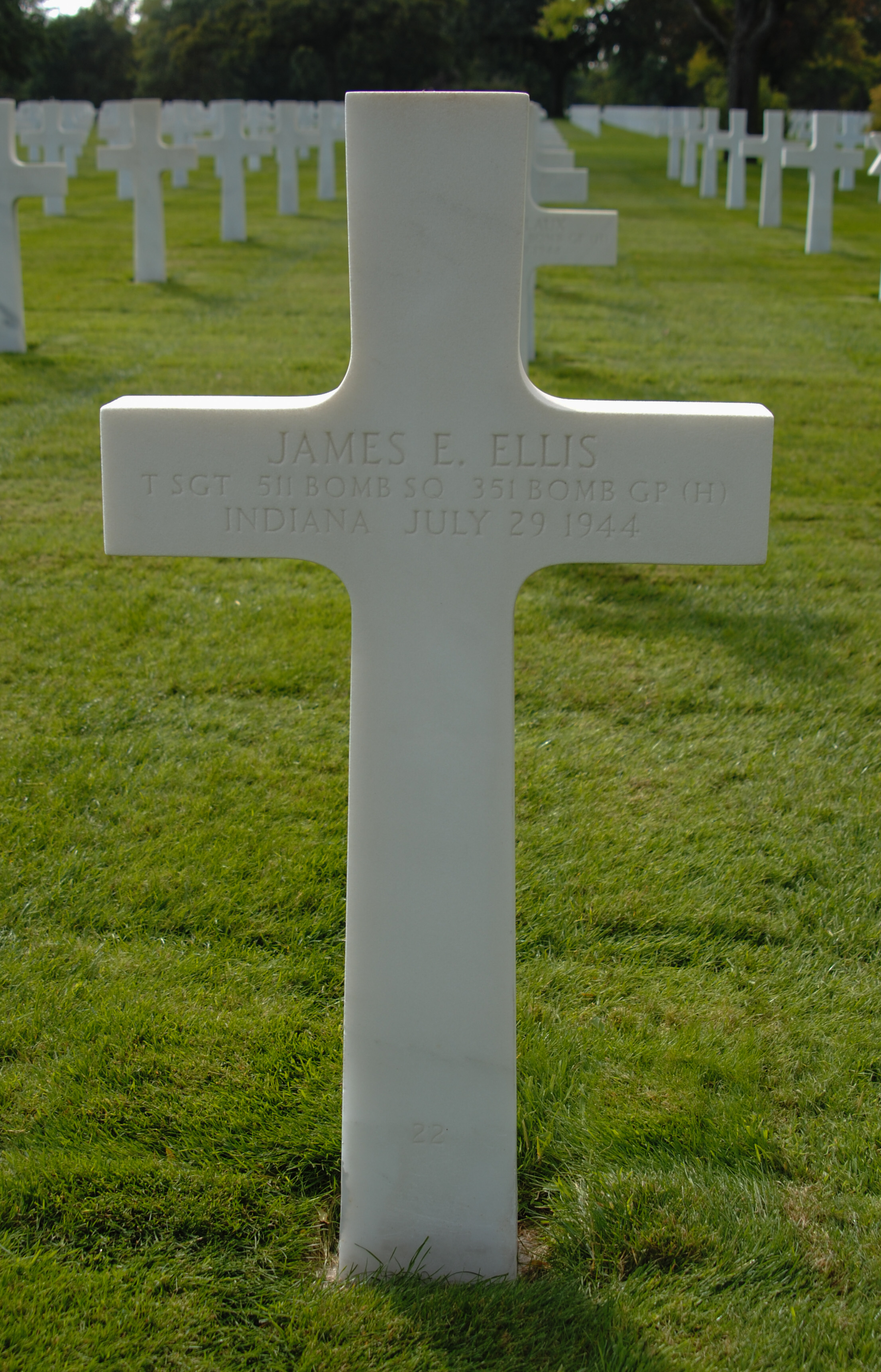
    • Top Turret Gunner - T/Sgt Ellis, James E., Killed in Action
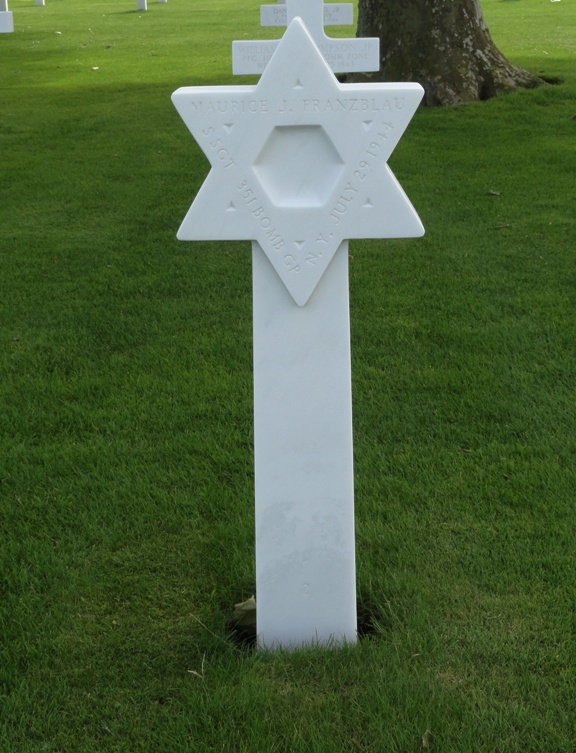
    • Radio Operator - S/Sgt Franzblau, Maurice J., Killed in Action
    • Left Waist Gunner - Sgt McGuire, Clarence B., Killed in Action
    • Right Waist Gunner - Position Not Manned
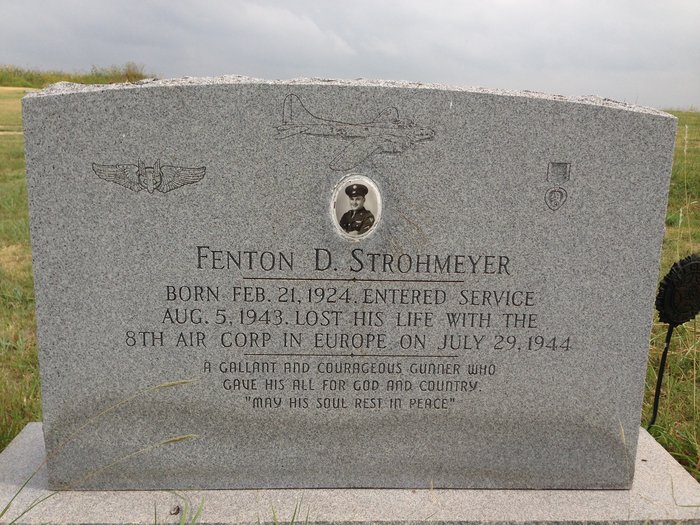
    • Ball Turret Gunner - Sgt Strohmeyer, Fenton D., Killed in Action
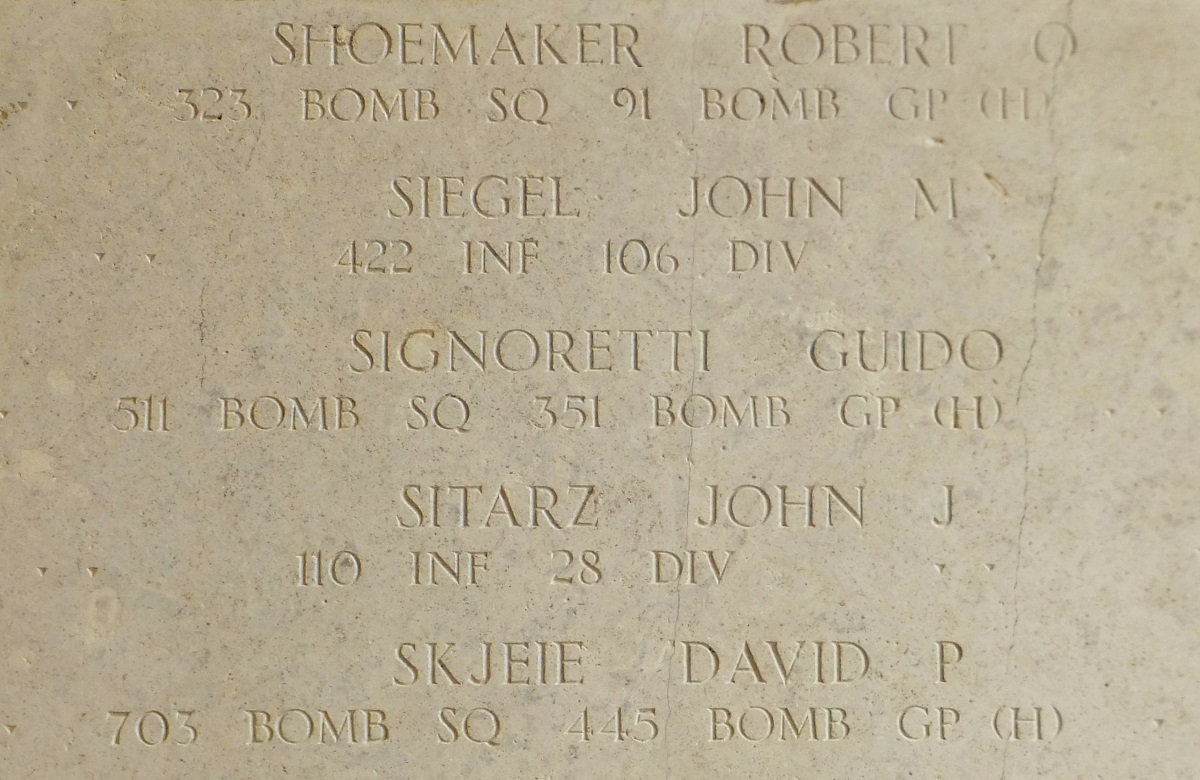
    • Tail Gunner - Sgt Signoretti, Guido, Missing in Action
    Burial Records:

    The burial records below courtesy of the American Battle Monuments Commission. http://www.abmc.gov and findagrave.com
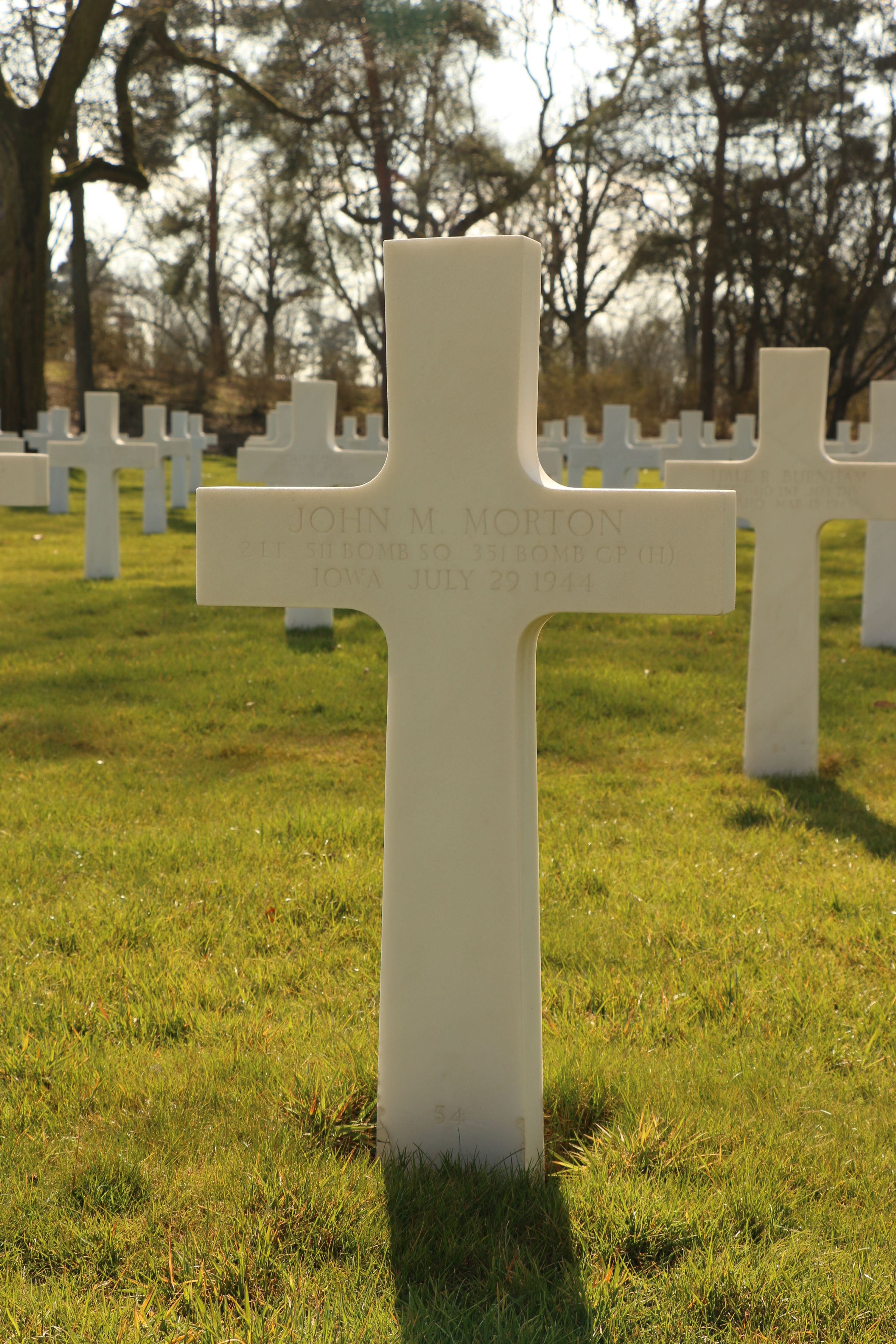
    • 2nd Lt Morton, John M., Buried: Plot A Row 22 Grave 54, Lorraine American Cemetery, St Avold, France, Awards: Air Medal, Purple Heart.
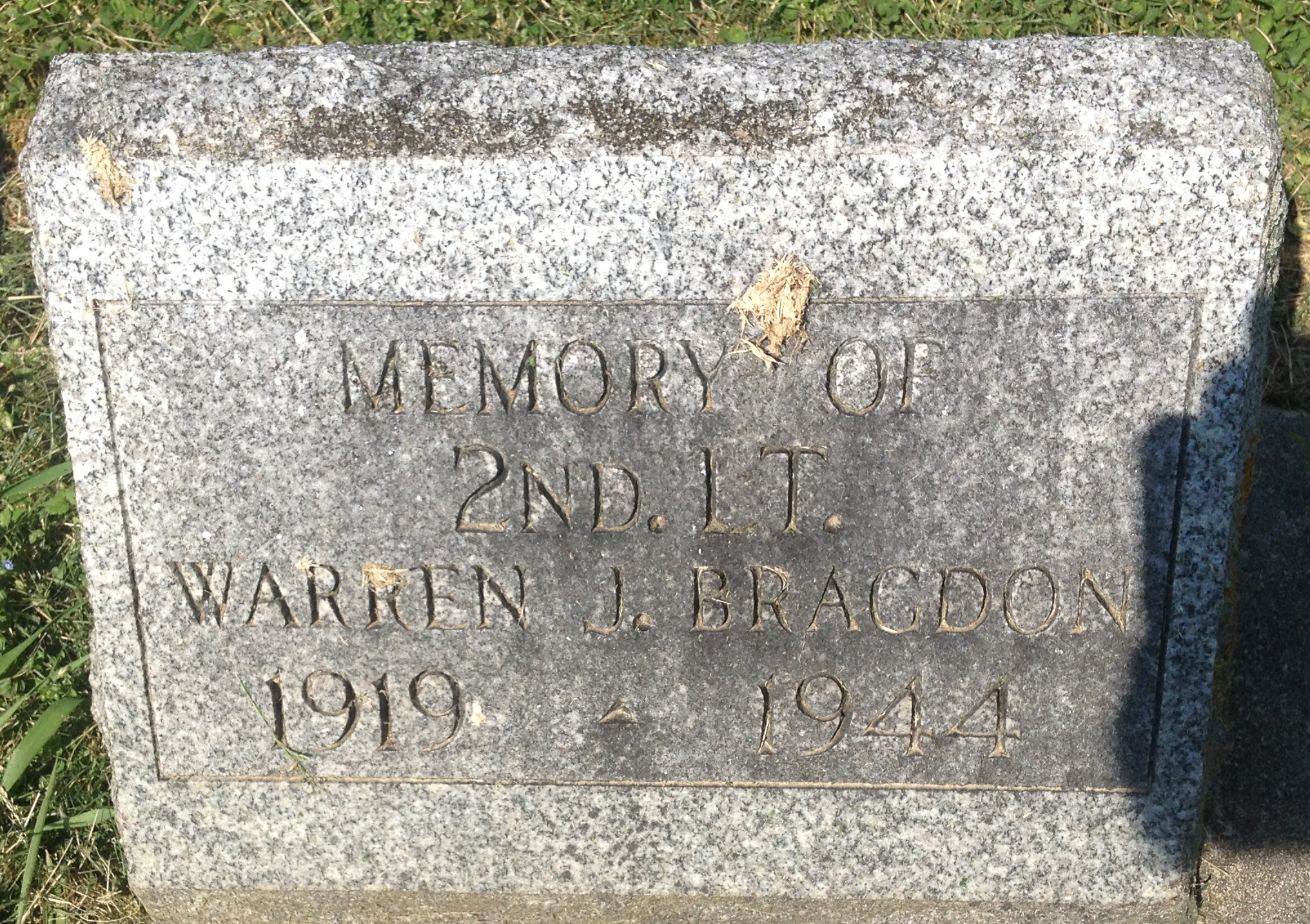
    • 2nd Lt Bragdon, Warren J., his body was initially buried by Sheriff of Bloesien [3.5 miles SW of Merseburg] at Blossien cemetery grave no. 1 on 30 July 1944 at 1600. Reinterred, Plot E Row 13 Grave 36, Lorraine American Cemetery, St Avold, France, Awards: Purple Heart.
    • 2nd Lt Fuerth, William J., Memorialized - Tablets of the Missing, Henri-Chapelle American Cemetery, Hombourg, Belgium, Awards: Air Medal, Purple Heart.
    • 2nd Lt Taylor, McCaleb D., Memorialized - Tablets of the Missing, Henri-Chapelle American Cemetery, Hombourg, Belgium, Awards: Air Medal, Purple Heart.
    • T/Sgt Ellis, James E., Buried - Plot E Row 42 Grave 22, Lorraine American Cemetery, St Avold, France, Awards: Air Medal, Purple Heart
    • S/Sgt Franzblau, Maurice J., initially buried in the cemetery of Benndorf, Grave 6, Reburied - Plot E Row 19 Grave 2, Netherlands American Cemetery, Margraten, Netherlands, Awards: Air Medal, Purple Heart
    • Sgt McGuire, Clarence B., initially buried in the cemetery of Benndorf, Germany, Grave 5, Reinterred at Saint Mary's and Saint Joseph's Cemetery, Fort Edward, Washington County, New York, USA, Plot: Section B - Lot 34.
    • Sgt Strohmeyer, Fenton D., initially buried in the cemetery of Benndorf, Germany, Reinterred at Memorial Hill Cemetery, Waynoka, Woods County, Oklahoma, USA, Plot: Row 12
    • Sgt Signoretti, Guido, Missing In Action, Memorialized - Tablets of the Missing, Henri-Chapelle American Cemetery, Hombourg, Belgium, Awards: Air Medal, Purple Heart

Click on Photo to Enlarge


Killed in Action:
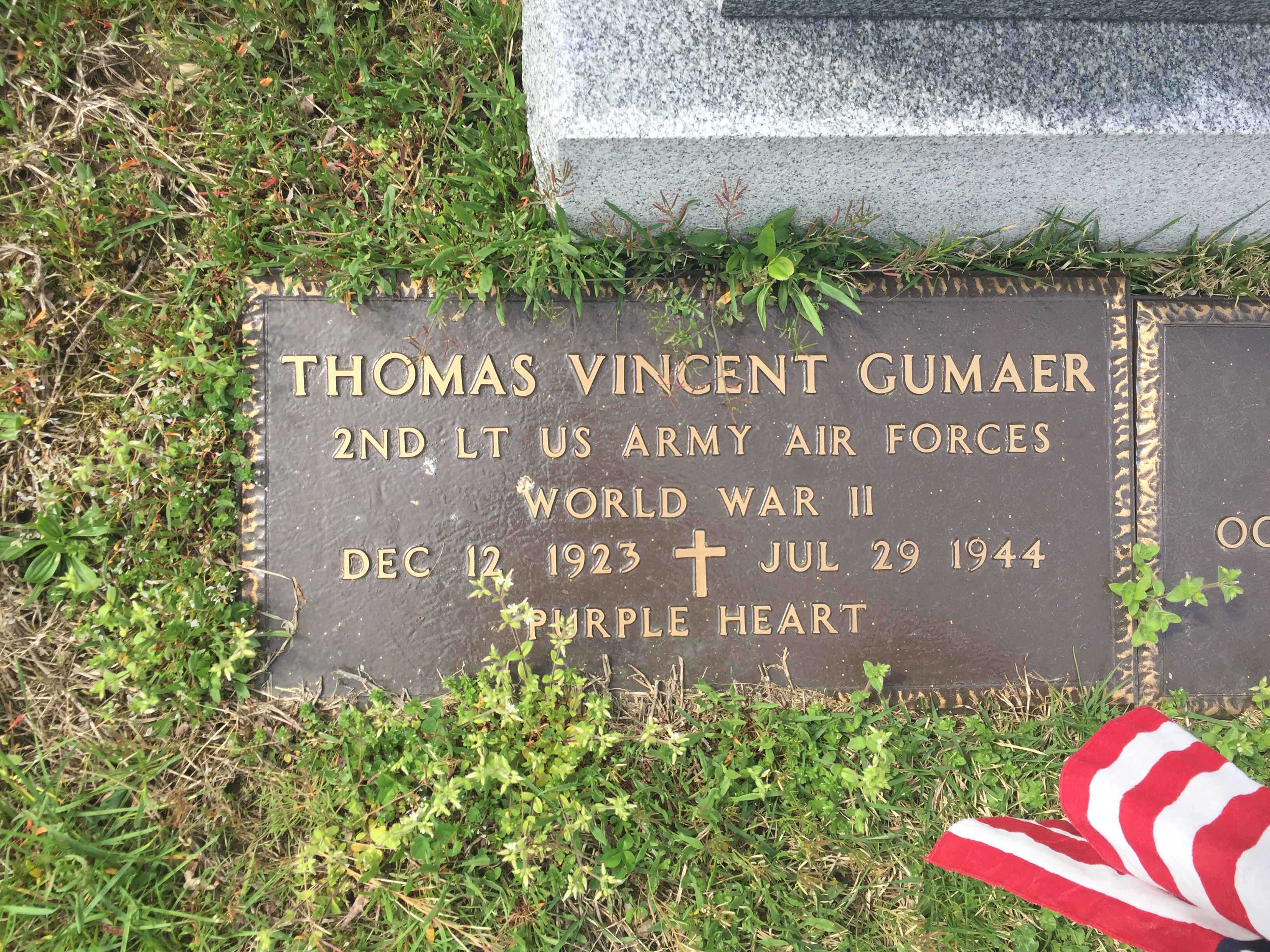
  • 2nd Lt. Gumaer, Thomas V. , Bombardier on Aircraft 43-37705 was Killed in Action on 29 July 1944, his 15th Mission.
    Burial: Saint Marys Cemetery, Yonkers, Westchester County, New York


Click on Photo to Enlarge

 [Killed in Action - 10]
 [Wounded - 1]

The above records were obtained at the National Archives Records Administration and have been declassified by authority NND 745005
Please contact us with your comments and corrections.